Vault operating model
Map Veeva Vault AI readiness against content structure, metadata, roles, security, workflow ownership, and the validated state of each Vault application.
Veeva AI readiness
USDM helps life sciences organizations prepare Veeva Vault for Veeva AI, Veeva Vault AI, AI feature enablement, validation impact, and managed services without letting regulated workflows outrun the evidence.


Latest Veeva white paper
AI-Ready Veeva Vault Operating Model
AI use case white paper
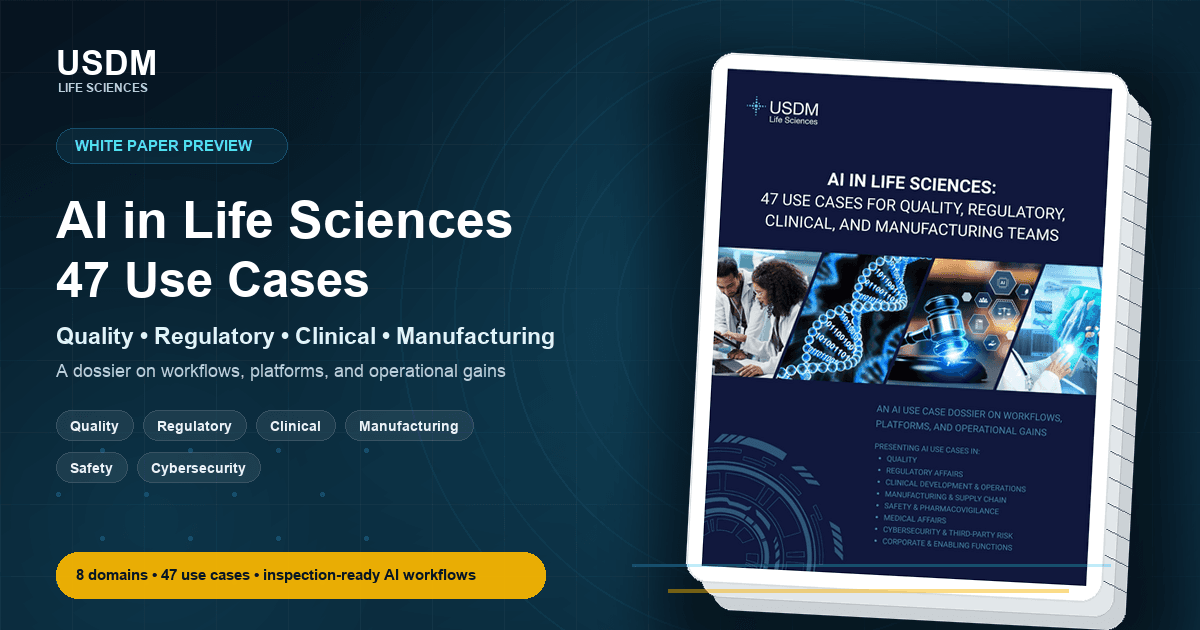
AI in Life Sciences: 47 Use Cases
Readiness path
Controlled Enablement Program
Veeva AI and Vault AI are not just product features for regulated organizations. They affect how teams classify content, approve work, review AI output, manage access, preserve audit trails, validate intended use, and operate Veeva releases over time.
USDM helps organizations turn interest in Veeva AI into a controlled enablement program. That means choosing the right use cases, preparing Vault data and metadata, defining Veeva AI governance, assessing validation impact, training users, and supporting the environment after launch through Veeva managed services.
Map Veeva Vault AI readiness against content structure, metadata, roles, security, workflow ownership, and the validated state of each Vault application.
Define intended use, risk controls, human review, audit trail expectations, validation strategy, and evidence retention before AI-enabled workflows expand.
Evaluate Veeva AI, Vault AI, AI Agents, AI Shortcuts, and embedded platform capabilities through a governed enablement path instead of one-off activation.
Keep releases, configuration changes, support tickets, regression testing, training, and optimization tied to a continuous Veeva managed services model.
Enablement model
The work starts before feature activation. USDM combines Veeva implementation partner support, AI governance, validation strategy, Cloud Assurance, and managed services so Veeva AI feature enablement stays practical, traceable, and useful after go-live.
Inventory current Vault applications, AI-enabled features, data, metadata, and business owners.
Classify Veeva AI use cases by GxP impact, data sensitivity, human review needs, and business value.
Define the Veeva AI governance model: intended use, roles, access, escalation, audit trail, and change control.
Assess validation impact for Vault AI features, integrations, prompts, outputs, workflows, and release changes.
Enable priority features through controlled pilots with training, adoption metrics, and documented evidence.
Operate through USDM managed services, Cloud Assurance, release readiness, and continuous optimization.
Featured resources
Latest Veeva white paper
A practical roadmap for preparing Vault data, workflows, governance, validation, and support models before Veeva AI becomes part of regulated work.
Open resourceAI use case white paper
Use the AI use case dossier to prioritize quality, regulatory, clinical, manufacturing, safety, and commercial workflows that can be governed and validated.
Open resource
Veeva datasheet
See how USDM supports Veeva Vault managed services, optimization, Cloud Assurance, validation lifecycle management, and regulated Veeva operations.
Open resourceProof
USDM supports Veeva Vault teams across implementation, optimization, advisory, integrations, validation, release readiness, and managed services. AI readiness builds on that foundation rather than starting from a blank governance template.
250+
USDM brings hands-on Veeva implementation, optimization, validation, advisory, integration, and managed services experience across regulated environments.
900+
Our Veeva AI readiness work sits inside 25+ years of life sciences compliance, validation, quality, regulatory, clinical, and data expertise.
20-40%
USDM Veeva optimization engagements have helped teams improve workflow throughput, reduce configuration drag, and strengthen operational governance.
30-40%
A better operating model reduces preventable support burden by tightening governance, training, release readiness, and continuous improvement.
ACT NOW
Teams searching for Veeva AI, Veeva Vault AI, Veeva AI feature enablement, Veeva AI governance, Veeva implementation partner support, and Veeva managed services are usually trying to solve the same problem: how to move faster without creating a validation or inspection mess.
The answer is not more policy theater. The answer is a practical Veeva operating model that connects business use cases, platform configuration, release impact, AI oversight, and managed support.
Frequently Asked Questions
Veeva AI readiness is the work required before AI-enabled Veeva Vault features are activated in regulated workflows. It includes use case selection, data and metadata quality, role design, security, validation impact assessment, human oversight, audit trail expectations, training, and release governance.
Treat Veeva Vault AI as a governed operating-model change, not a toggle. Teams should define intended use, classify risk, confirm data quality, assess validation impact, pilot priority workflows, train reviewers, and maintain evidence through release and change control.
Veeva AI feature enablement involves evaluating available and planned Veeva AI capabilities, selecting appropriate Vault use cases, setting access and oversight controls, validating the affected workflow, documenting decisions, and measuring adoption after launch.
Veeva AI governance matters because AI can affect regulated records, decisions, content, and workflows. Governance defines who owns the use case, what the system is allowed to do, when humans review output, how exceptions are handled, and what evidence is retained for audit or inspection.
Yes. USDM supports Veeva implementation, optimization, AI readiness, validation, Cloud Assurance, and managed services for life sciences teams that need a practical partner to prepare Vault environments for governed AI adoption.
Next step
USDM can help assess your Vault environment, prioritize AI use cases, design governance, validate the impact, and operate the program through Veeva managed services.