Executive takeaways
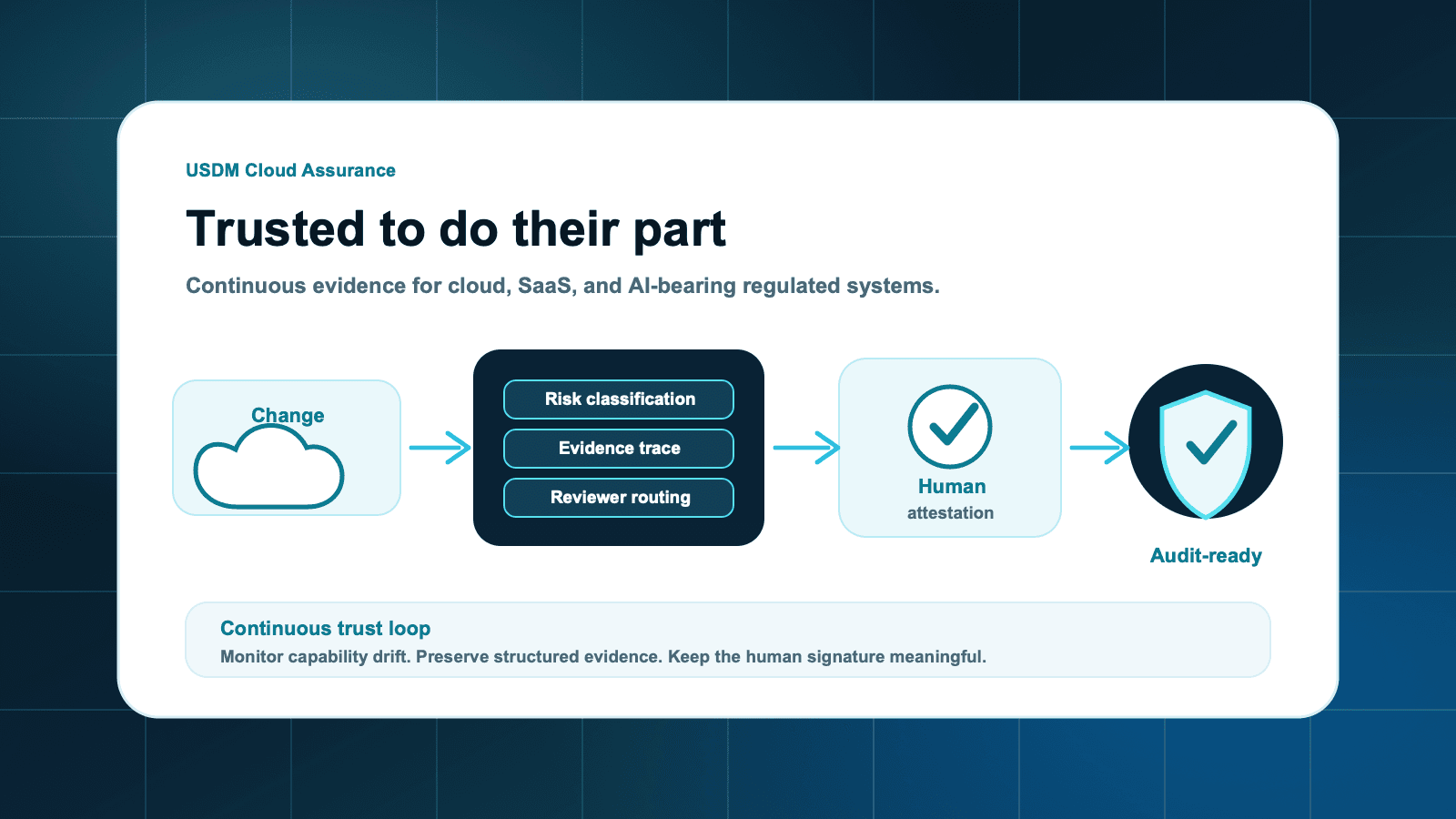
- The core validation question has not changed: regulated software still has to be trusted to do its part in producing safe medicines, safe devices, safe data, and safe decisions.
- The system boundary has changed: modern cloud and AI-bearing systems may reason, retrieve, classify, route, and act in ways traditional release validation was not designed to monitor.
- Continuous evidence is the new center of gravity: audit-ready artifacts still matter, but quality teams increasingly need structured evidence, reasoning traces, and capability monitoring.
- Human review remains essential: USDM Cloud Assurance should elevate reviewers toward judgment-rich work while preserving human attestation for consequential decisions.
For more than two decades, USDM Life Sciences has been answering one question on behalf of the life sciences industry: Can this computer system be trusted to do its part of the job? The job is producing safe medicines, safe devices, safe data, and safe decisions for patients. The system is whatever software the customer's quality unit has chosen to deploy, and increasingly, whatever software that system has chosen to deploy inside itself.
The question is the same one we have asked since 21 CFR Part 11 was new. The systems are not.
The constant
USDM Cloud Assurance exists because regulated software changes faster than regulated quality systems can keep up. When USDM Cloud Assurance launched, the gap was measured in months: a vendor would ship a release, and the customer's validation team would catch up by the next quarter. The service collapsed that gap. Audit-ready artifacts produced continuously, mapped to 21 CFR Part 11 and EU Annex 11, signed and traceable, ready for the inspector who arrives without notice.
That commitment has not changed. It will not change. Whether the regulated system is a hosted electronic batch record system from 2014, a software-as-a-service quality management platform from 2020, or an agentic clinical-trial assistant from 2026, the obligation is identical. The system, however powerful and however complex, must be trusted to do its part. USDM Cloud Assurance is the mechanism through which that trust is established and renewed.
What "doing their part" now means
A regulated computer system in 2014 ran a discrete function: store this batch record, capture this electronic signature, route this deviation. The validation question reduced to a manageable form: does the system do what its specification says it does, every time, under every relevant condition?
A regulated computer system in 2026 reasons. It reads release notes the customer's quality unit has not read yet. It drafts impact assessments. It retrieves regulatory precedent. It proposes classifications. It increasingly takes actions on the customer's behalf: filing, routing, escalating, even closing under degrees of autonomy that did not exist as a concept in the original Part 11 record.
"Doing their part" used to mean execute the specified function. It now means execute the function correctly and reason about the function correctly and recognize when the function should not execute at all. A reasoning system that processes a thousand release notes per quarter is doing its part only if every one of those thousand reasoning steps is traceable, attestable, and reproducible to the standard an FDA or EMA inspector requires. A specification document alone does not produce that trust. Continuous evidence does.
From vendor change to continuous trust
Change signals
- Vendor releases
- Model and prompt changes
- Retrieval-source updates
- Configuration drift
- Autonomy settings
USDM Cloud Assurance controls
- Detect: monitor release and capability change.
- Classify: score GxP and AI-bearing risk.
- Evidence: retain rationale, sources, and signatures.
- Attest: route decisions to the right reviewer.
Trust outputs
- Audit-ready evidence
- Quality decisions
- Human attestation
- Inspection support
The three shifts we are building for
The next decade of USDM Cloud Assurance is shaped by three shifts the life sciences industry is already feeling.
Human review depth follows the risk profile
Higher autonomy requires stronger evidence and review.
Records, signatures, routing, and closure carry different risk.
Irreversible action changes the approval path.
Broader exposure raises the attestation burden.
Weak evidence pushes work toward human sign-off.
The human has not been replaced. The human has been elevated.
The most consistent question USDM hears from quality leadership is the right one: If the system reasons, what is the role of the human reviewer?
Our position is straightforward. The human reviewer's role is not diminished by capable reasoning systems. It is elevated. A reviewer who once spent the working day classifying routine releases now spends the working day attending to the cases that warrant attention: the novel risk profile, the regulatory edge case, the customer-context nuance no system can know. The system handles volume; the human handles judgment. The signature still belongs to the human.
We are committed to a tiered model of human attestation, calibrated to risk. Routine, low-consequence, well-evidenced decisions can close under attestable system reasoning with reviewer reversal authority. Novel, high-consequence, or AI-feature-bearing decisions remain firmly in the human's sign-off. The reviewer is supported by the system, not bypassed by it. The signature carries the same legal and regulatory weight it always has, because the artifact behind it is more complete than it has ever been.
The forward commitments
Looking forward, USDM is committing the USDM Cloud Assurance service to five principles that will hold regardless of which technology platforms underpin the offering five or ten years from now.
- Continuous trustworthiness. Trust is not an annual exercise. The service will monitor regulated systems continuously, surface drift continuously, and renew evidence continuously. The binder-once-a-year posture is finished.
- Attestable reasoning. Every classification, every recommendation, every drafted artifact will carry a structured reasoning record. The customer's quality unit and the customer's inspector will be able to walk that record at any granularity.
- Calibrated autonomy. Systems will do as much of the work as the risk class permits, and no more. Where humans must sign, humans sign. Where systems can close under attestable evidence, systems close. The line between the two is governed, audited, and reviewed.
- Open ontology. Regulatory frameworks will continue to evolve. New AI guidance from the FDA and EMA, delegated acts under the EU AI Act, and harmonized standards from international bodies will keep changing the obligation. USDM Cloud Assurance will extend its underlying ontology to absorb them without rewriting the service from the ground up each time.
- Customer-side deployer support. The customer is increasingly the regulated party, not only for their use of vendor software, but for the conformity dossiers their inspectors will demand under the EU AI Act and the FDA's emerging Good AI Practice guidance. USDM Cloud Assurance will produce the deployer-side artifacts customers need, alongside the validation artifacts they have always received.
What does not change
USDM's commitment to the life sciences industry has been the same since the firm was founded. The systems we validate change. The regulatory frameworks we map against change. The technologies that power the USDM Cloud Assurance service itself change. The commitment does not change. Patients depend on regulated software to behave the way its quality unit says it behaves. Quality units depend on USDM to ensure that. USDM Cloud Assurance is the form in which that dependability is delivered.
When the next generation of regulated software is more autonomous, more reasoning-capable, and more continuously evolving than any prior generation, USDM Cloud Assurance will be the mechanism through which it earns the trust required to do its part. That is not a marketing position. It is the company's purpose.
A closing note for the quality leader reading this
If you lead a quality organization in life sciences and you are looking at the AI features arriving in your regulated software-as-a-service systems, reading the EU AI Act enforcement deadlines, and reading the FDA and EMA's joint AI guiding principles, you may be wondering how your unit will keep up. The answer is the one it has always been. You will not keep up by adding people. You will keep up by partnering with a managed compliance service designed for continuous trust at the pace of continuous change.
USDM Cloud Assurance is that service. It always has been. It always will be through every platform shift, every regulatory framework, every new generation of regulated computer system. Powerful, complex, and reasoning systems can be trusted to do their part. USDM exists to make sure they earn that trust, every release, every reasoning step, every signature.
That commitment is what carries forward.
FAQ: The Future of USDM Cloud Assurance
How does USDM Cloud Assurance change for AI-bearing SaaS systems?
USDM Cloud Assurance must monitor more than vendor release packages. AI-bearing systems can change through model versions, prompts, tools, retrieval sources, and autonomy settings. The assurance model therefore has to track capability behavior, classify risk across more dimensions, and retain evidence that explains why a decision was made.
Does AI remove the need for human validation review?
No. AI changes where human judgment is most valuable. Routine, low-risk work can be supported by attestable system reasoning, but novel, high-consequence, or AI-feature-bearing decisions still require accountable human sign-off. The goal is to focus reviewers on judgment, not bury them in volume.
Why is structured evidence important for inspectors?
Traditional artifacts show what was approved. Structured evidence helps show why it was approved, what sources were considered, how risk was classified, what confidence indicators existed, and who attested to the decision. That matters as regulated systems become more autonomous and more continuously changing.
Where should quality leaders start?
Start by identifying which regulated SaaS platforms are adding AI capabilities, how those capabilities change intended use, what human checkpoints exist, and what evidence would be needed during inspection. From there, USDM Cloud Assurance can help define monitoring, risk classification, and attestation patterns that scale.
USDM Life Sciences has served the life sciences industry for more than two decades. USDM Cloud Assurance is the firm's managed compliance service for regulated software-as-a-service workloads, designed to deliver continuous, audit-ready trust across the regulated software estate. Talk to USDM about USDM Cloud Assurance for AI-bearing regulated systems.