Executive takeaways
- Product information is moving from documents to structured data: electronic product information, or ePI, depends on content that can be reused, localized, exchanged, and governed across regions.
- HL7 FHIR is an interoperability enabler, not a silver bullet: mapping fields to a standard will not fix inconsistent source data, unclear ownership, or weak change control.
- Readiness is cross-functional: Regulatory, Quality, IT, Data, Labeling, Safety, and Commercial teams need a shared operating model for structured product information.
- AI readiness starts with governed data: machine-readable product information can support future AI, automation, and patient-centric digital experiences only when data integrity and validation are designed in.
Medicinal product information is one of the most important sources of regulated, scientifically validated content in life sciences. It informs how healthcare professionals prescribe and dispense medicines and how patients understand safe and effective use.
Yet much of this information is still managed in static documents, regional formats, disconnected repositories, and manual transformation steps. That model was built for documents. It is not well suited for a digital environment where regulators, health systems, patients, and technology platforms increasingly expect structured, searchable, exchangeable information.
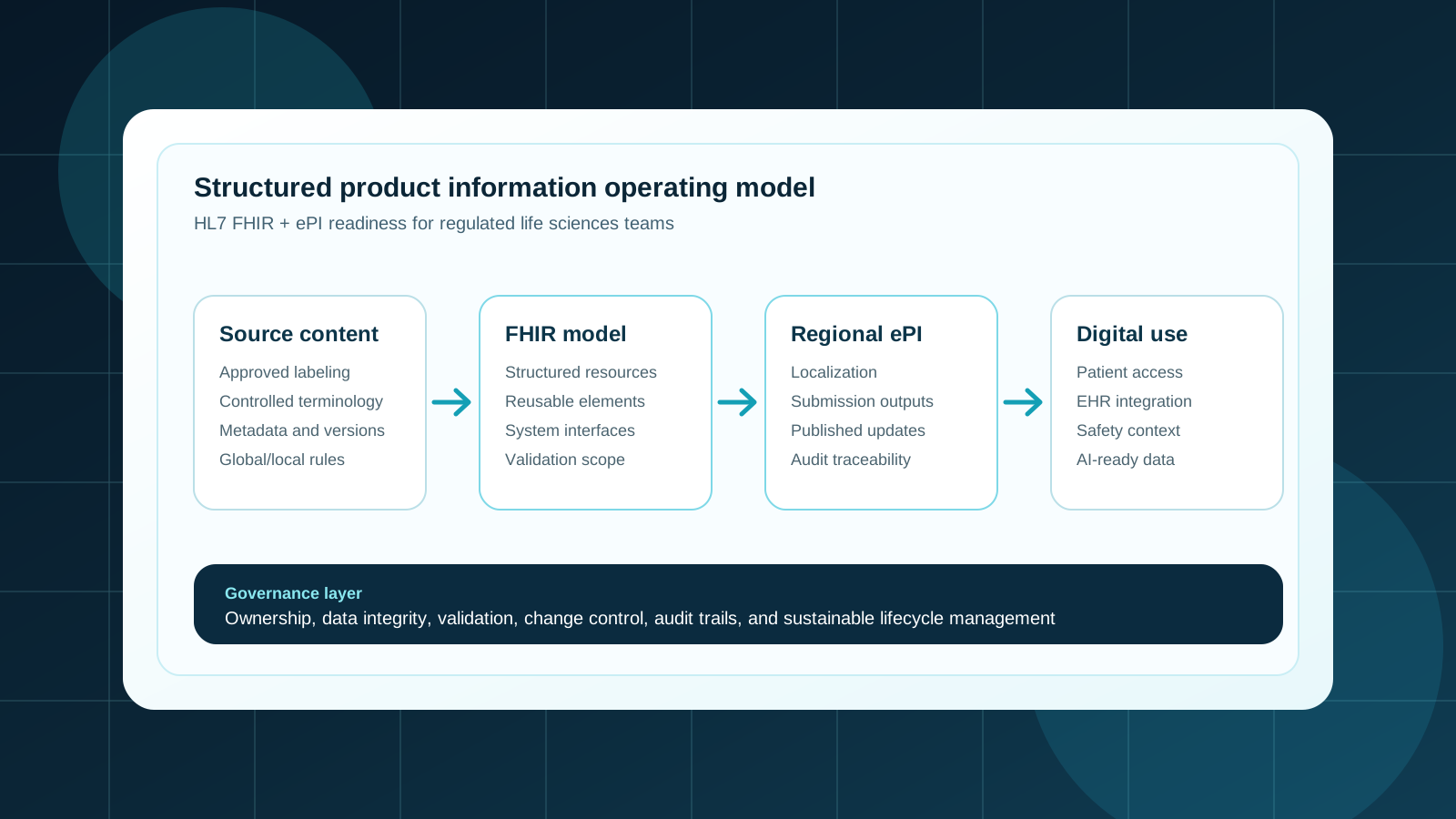
HL7 FHIR and electronic product information, or ePI, are changing that expectation. Together, they point toward a future where product information is maintained as structured, governed data that can move across systems and use cases while preserving regulatory trust.
Why structured product information matters now
The strategic value is significant. A common ePI standard can help organizations reduce duplication, support regional localization, improve content consistency, and create a stronger foundation for patient-centric digital experiences. It can also support future integration with electronic health records, diagnostics, wearables, and other datasets that shape how product information is delivered and used.
For regulated organizations, the opportunity is not just to comply with a standard. The larger opportunity is to modernize the operating model behind product information.
That operating model matters because product information does not live in one neat place. Regulatory content often spans labeling systems, regulatory information management platforms, document management systems, quality workflows, publishing tools, affiliate processes, submission workflows, and local market variations. If those foundations are inconsistent, FHIR-enabled exchange can make the gaps more visible.
Interoperability depends on data integrity. If the underlying data is inconsistent, incomplete, poorly governed, or disconnected from controlled processes, a new exchange standard will not solve the problem. It will simply move the problem faster.
Why this matters for life sciences leaders
The move toward FHIR-based ePI introduces questions that reach well beyond Regulatory Operations or IT architecture:
- How should product information be structured at the source?
- How will content be governed across global and local requirements?
- How will teams maintain traceability between approved content, structured data elements, translations, submissions, and published outputs?
- How will systems exchange data without compromising validated state, data integrity, or regulatory accountability?
- How will companies prepare for regional ePI profiles while maintaining a scalable global baseline?
Those questions require a coordinated strategy across people, process, platforms, data governance, validation, and change management. They also require practical alignment between the teams that create product information, the systems that manage it, and the controls that prove it can be trusted.
Move from document conversion to governed product information lifecycle
Assess
- Content sources
- Manual handoffs
- Data quality gaps
Govern
- Ownership model
- Controlled vocabulary
- Version rules
Sustain
- Validation evidence
- Regional profiles
- Lifecycle monitoring
HL7 FHIR readiness requires more than mapping
Many organizations begin a FHIR conversation with mapping. That is necessary, but it is not enough. A defensible HL7 FHIR and ePI strategy should include several readiness domains.
Readiness domains for FHIR-based ePI
- Current-state assessment: understand where medicinal product information lives today, how it moves across systems, where manual transformations occur, and which processes create compliance or operational risk.
- Data governance and ownership: define ownership, controlled vocabularies, metadata standards, version control, lifecycle rules, and accountability for global and local content.
- Regulatory and Quality alignment: implement FHIR-based ePI in a way that supports regulatory expectations, inspection readiness, data integrity, auditability, and controlled change.
- Platform and integration strategy: determine how FHIR will interact with RIM, labeling, document management, quality systems, data platforms, and publishing tools.
- Validation and compliance strategy: evaluate system changes, data exchanges, interfaces, and automated workflows through intended use, risk, controls, and ongoing monitoring.
- Change management: help teams that have worked in document-based processes adopt structured content models with the right training, governance, and operational support.
This is also where broader USDM capabilities come together. FHIR-based ePI depends on data integration and interoperability, data integrity, Computer Software Assurance, and disciplined continuous compliance practices. The standard is technical, but the readiness problem is operational.
How USDM supports HL7 FHIR and ePI readiness
USDM helps life sciences organizations assess, implement, validate, and sustain regulated digital transformation across quality, regulatory, clinical, manufacturing, IT, and data environments. For HL7 FHIR and ePI initiatives, that support can span the full lifecycle.
Assess the product information landscape
USDM can evaluate current systems, workflows, data sources, content structures, regional variations, governance gaps, validation considerations, and integration dependencies. A readiness assessment can cover HL7 FHIR adoption, ePI operating models, regulatory information management, labeling and structured content processes, data integrity and metadata maturity, system and interface validation, and AI or automation readiness.
Design the future-state model
Structured medicinal product information needs an operating model. USDM can help define governance frameworks, process design, role clarity, data standards, controlled terminology approaches, and business rules that align with regulatory and operational needs.
Implement across systems and workflows
FHIR requirements have to land in real technology ecosystems. USDM can support implementation across systems, integrations, workflows, and data models while accounting for the realities of regulated platforms and existing business processes.
Validate with risk and intended use in mind
FHIR-enabled ePI requires a risk-based validation strategy that reflects intended use, system impact, data criticality, interface behavior, security, audit trails, and lifecycle controls. USDM brings more than 25 years of life sciences compliance experience to help organizations establish defensible validation approaches that support speed without sacrificing control.
Sustain beyond go-live
FHIR and ePI are not one-time projects. As standards evolve, regional profiles mature, systems change, and business needs expand, organizations need sustainable governance and support. USDM can provide managed services, continuous compliance support, process optimization, and ongoing system lifecycle management to help organizations maintain control after launch.
The bigger opportunity: AI-ready regulatory information
FHIR-based ePI is part of a larger shift toward AI-ready, machine-readable regulatory data. As life sciences organizations explore AI for regulatory intelligence, labeling automation, content reuse, safety surveillance, patient engagement, and decision support, the quality and structure of product information becomes increasingly important.
AI does not fix fragmented data. It amplifies it.
Organizations that invest now in structured product information, governed metadata, interoperable standards, and validated data flows will be better positioned to use AI responsibly and compliantly. That aligns with USDM's broader guidance on AI governance and compliance: AI readiness depends on data integrity, governance, traceability, and controlled processes.
HL7 FHIR is not just a standard for exchange. It is an enabler of the next generation of regulatory, clinical, safety, and patient-facing innovation.
Our point of view
The future of medicinal product information will not be built on static documents alone. It will be built on structured, governed, interoperable data that can move across systems, regions, and use cases while preserving regulatory trust.
For life sciences organizations, HL7 FHIR and ePI create an opportunity to modernize product information from the inside out. The companies that act early will be better prepared to reduce manual content transformation, improve global and local consistency, strengthen data integrity, support regulatory interoperability, enable more patient-centric product information, prepare for AI and automation, improve inspection readiness, and scale future digital initiatives with less friction.
Success requires more than technical conversion. It requires a compliant operating model, strong governance, validated systems, and cross-functional alignment.
USDM helps organizations build that foundation.
FAQ: HL7 FHIR and ePI readiness
What is ePI in life sciences?
Electronic product information, or ePI, is a digital approach to medicinal product information that can support structured, searchable, and exchangeable content. Instead of treating product information only as static documents, ePI helps organizations manage approved content as reusable data.
Why does HL7 FHIR matter for ePI?
HL7 FHIR provides a standards-based way for systems to exchange structured healthcare information. For ePI, it can help product information move across systems and regional profiles while preserving context, but only if source data, ownership, validation, and governance are strong enough.
Is FHIR readiness mainly an IT project?
No. IT is essential, but FHIR-based ePI also affects Regulatory, Quality, Labeling, Safety, Data, Commercial, and affiliate teams. The work requires a shared operating model for content ownership, metadata, regional localization, traceability, validation, and change control.
What is the first step toward HL7 FHIR and ePI readiness?
Start with a current-state assessment. Identify where product information lives, how it moves, where manual transformations occur, which data elements lack ownership, and which interfaces or workflows may affect regulated records or validated systems.
How does ePI support AI readiness?
AI depends on reliable, structured, well-governed data. FHIR-based ePI can improve the quality and usability of regulatory product information for future AI, automation, safety, and patient-facing use cases, but the data must remain traceable, controlled, and validated where regulated use applies.
Start with an HL7 FHIR and ePI readiness assessment
USDM can assess your current HL7 FHIR and ePI readiness and map a practical path forward across strategy, compliance, data, technology, validation, and managed services. Contact USDM to understand where you are today, where interoperability expectations are heading, and what it will take to get there with confidence.