
Top 10 critical considerations life-science organizations must evaluate when implementing Google Agentspace
Quick Summary
Adopting an AI agent platform in a regulated environment is not a technology decision alone—it is a compliance, security, and operational decision. This article distills the ten evaluation factors life-science organizations consistently raise when assessing Google Agentspace: regulated-industry compliance, data security and residency, auditability, system integration, multi-agent governance, domain-tuned performance, deployment flexibility, validation accelerators, cost transparency, and a credible no-lock-in roadmap. Use it as a checklist before you pilot, and as a governance baseline once you scale.
Artificial intelligence is revolutionizing every industry, and the life sciences sector is no exception. Adopting AI-driven platforms like Google Agentspace in this highly regulated domain brings both opportunity and complexity. Organizations must navigate strict compliance requirements, ensure data security, and deliver measurable returns. Google Agentspace for life sciences offers a promising solution tailored for the nuanced needs of pharmaceutical, biotech, and clinical research companies.
This article outlines the ten key priorities that life-science organizations consistently highlight when evaluating Google Agentspace, serving as a comprehensive roadmap to successful adoption.
Before you pilot: Treat these ten factors as gating criteria, not a wish list. A platform that scores well on capability but cannot produce inspection-ready evidence will stall in validation. Pair every capability question with a corresponding governance question—and decide who owns the answer before the proof-of-concept begins.
1. Regulated-Industry Compliance
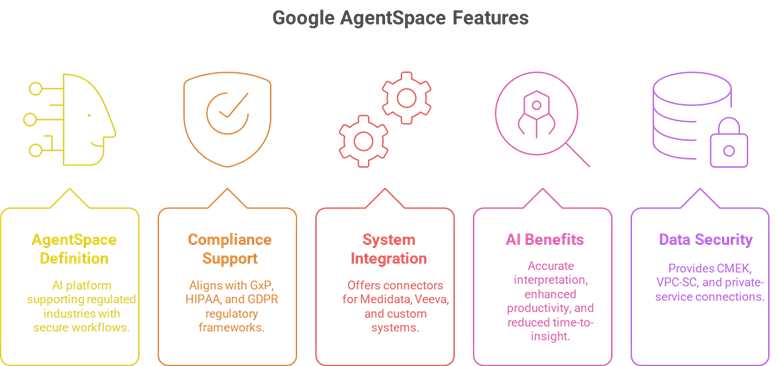
Designed and continuously aligned with GxP Quality, Compliance, and Security guidelines and regulations such as FDA 21 CFR Part 11, HIPAA (US Health Privacy), GDPR (EU Data Protection), NIST CSF (Cybersecurity Framework), NIS-2 Directive (EU Cybersecurity), EU AI Act, etc. Many of these are non-negotiable for life-science organizations. Google Agentspace aligns seamlessly with these frameworks through its support for FedRAMP and Virtual Private Cloud-Service Controls (VPC-SC). Moreover, its roadmap for GxP certification simplifies integration into validation workflows, making the Computer System Validation (CSV) process less burdensome.
Such proactive compliance features reassure quality, regulatory, IT, data protection and privacy, and cybersecurity teams that the platform can be safely and efficiently incorporated into regulated environments without compromising audit readiness or legal standards. Where requirements span FDA, EU, and cybersecurity regimes simultaneously, a defined AI governance and compliance program keeps those obligations from becoming an afterthought.
2. Granular Data Security & Residency
Data integrity and confidentiality are paramount in life sciences. Google Agentspace provides robust encryption at rest and in transit and support for Customer-Managed Encryption Keys (CMEK), VPC-SC, and private service connections.
What sets Agentspace apart is Google’s transparent policy of ensuring that customer data is not used to train its models. This builds significant trust, especially for companies dealing with proprietary research data or sensitive patient information, by offering strong assurances around data sovereignty and residency. Sustaining that posture as agents reach across systems is where disciplined life-sciences cybersecurity practices do the heavy lifting.
3. Auditability & Traceability
Compliance isn't just about controls—it's also about evidence (documentation). Agentspace offers comprehensive, immutable logs that capture every interaction. These logs track user identities, input prompts, agent versions, model configurations, and output responses.
Crucially, these detailed logs can be seamlessly exported into existing Quality Management Systems (QMS) or electronic Trial Master Files (eTMFs), simplifying both internal audits and external inspections—this high degree of traceability through leverageable assets that provide the meticulous evidence required in regulated life sciences.
In regulated life sciences, the question is never just “what did the agent do?” It is “can you prove it, repeatably, to an inspector?”
4. Seamless Integration with Scientific Systems
AI adoption must integrate into the broader digital ecosystem of scientific research. Google Agentspace excels by offering out-of-the-box connectors for electronic lab notebooks (ELNs) like Benchling and LabVantage, clinical systems like Medidata and Veeva, quality platforms such as TrackWise, and enterprise resource planning (ERP) systems like SAP.
Moreover, Agentspace supports the creation of secure, custom connectors tailored to each organization’s proprietary systems—essential for IP-sensitive use cases. The integration layer that binds agents to validated systems—MCP connectors and skills—deserves the same scrutiny as the agents themselves, because that is where regulated data actually moves.
5. Multi-Agent Workflow Governance
The complexity of life-science workflows demands robust governance. Agentspace delivers features like agent version control, role-based access control (RBAC), human-in-the-loop approvals, and rollback mechanisms.
Recent innovations like the Agent Designer and governance APIs have been well-received by compliance teams. These tools centralize management, simplify validation processes, and ensure that agents behave consistently across updates—accelerating approval cycles and reducing compliance risks. Governing agents inside GxP workflows is its own discipline that applies directly to multi-agent Agentspace deployments.
A simple lens: capability vs. control
Every factor below pairs a capability question with a control question. Score both before you commit.
- Compliance & Security — Capability: does it support the frameworks we operate under? Control: who validates the configuration and re-validates on change?
- Integration & Performance — Capability: does it connect to our ELN, CTMS, and QMS? Control: how is data in those connectors protected and logged?
- Governance & Auditability — Capability: can we version, approve, and roll back agents? Control: can we produce inspection-ready evidence on demand?
- Economics & Roadmap — Capability: is pricing and ROI predictable? Control: can we exit without lock-in if strategy changes?
6. Domain-Tuned Bio/Chemical AI Performance
Unlike generic AI tools, Agentspace demonstrates strong performance in interpreting biological and chemical content. It can parse Protein Data Bank files, conduct chemical graph reasoning, and integrate findings from domain-specific databases like PubMed and ClinicalTrials.gov.
These domain-tuned capabilities have been effectively showcased through Google’s Gemini-powered co-scientist demos, making a compelling case for the platform’s utility in cutting-edge biomedical research and clinical development.
7. Deployment Flexibility for Sensitive IP Workloads
Life-science organizations span a wide range of operational needs—from early-stage discovery to submission-critical IND processes. Agentspace’s deployment flexibility enables organizations to choose between cloud-based SaaS offerings or fully air-gapped, on-premise Anthos clusters.
This level of flexibility supports compliance with export control laws and helps protect high-value intellectual property, ensuring that no trade-offs are needed between innovation and security. When agents draw on third-party models and external services, this flexibility must not quietly widen the attack surface.
8. Validation Accelerators & Partner Ecosystem
Validation is a significant time and cost driver in regulated industries. Agentspace streamlines this through a robust suite of pre-written validation scripts, CSA STAR certifications, and integration with GxP-experienced partners like USDM.
Google’s curated partner agent catalog also helps organizations implement standardized workflows faster, while still allowing customization to suit unique operational or compliance needs. Approaching qualification through a Computer Software Assurance (CSA) lens—risk-based, evidence-driven—and managing it over time with validation lifecycle management is how those accelerators translate into a sustained, inspection-ready state.
9. Transparent Cost Structure & ROI Metrics
Financial stakeholders need clear cost visibility and ROI projections. Agentspace delivers a predictable pricing model—whether based on agent-hours or token usage—allowing for precise budget planning.
Organizations can track key performance indicators (KPIs) like increased document throughput, shorter review cycles, and full-time equivalent (FTE) savings. These tangible metrics help demonstrate the platform’s value beyond just technological innovation.
10. Credible Roadmap & No Vendor Lock-In
In today’s multi-cloud world, flexibility is paramount. Agentspace’s open approach—supporting third-party large language models (LLMs), adhering to open standards like the Agent-to-Agent protocol, and making clear public commitments—mitigates the risk of vendor lock-in.
This strategic transparency empowers organizations to evolve their AI strategies over time without being constrained by proprietary limitations.
USDM Perspective
As a trusted compliance partner in the life-science industry, we strongly endorse these ten evaluation factors as foundational to any successful technology adoption.
By addressing regulatory, security, and operational needs from day one, Google Agentspace enables life-science organizations to innovate confidently. USDM supports seamless deployment and long-term success through validation accelerators, strategic integrations, and a strong partner ecosystem—backed by an agentic AI team that specializes in bringing agents into regulated, validated environments.
AI-driven platforms like Google Agentspace hold transformative potential for life sciences—but only when deployed with full awareness of regulatory, technical, and operational requirements.
From compliance to cost transparency, each of the top ten priorities outlined here contributes to a holistic and successful adoption strategy. With its domain-tuned capabilities, flexible deployment, and governance-ready architecture, Google Agentspace is well-positioned to become a cornerstone of digital transformation in the life sciences industry.
Learn more about AI in life sciences in this white paper: A Comprehensive Guide to Responsible AI for Life Sciences.
FAQ: Evaluating Google Agentspace for Life Sciences
What is Google Agentspace, and why does it matter in life sciences?
Google Agentspace is an AI platform built to support highly regulated industries like life sciences with compliant, secure, and domain-specific agent workflows. It matters because it brings agent-based automation into environments where audit readiness, data security, and validation are non-negotiable.
How does Agentspace support GxP and HIPAA compliance?
Agentspace aligns with regulatory frameworks including GxP, HIPAA, 21 CFR Part 11, and GDPR, and supports controls like FedRAMP and VPC-SC. It also provides exportable, immutable logs and a GxP-certification roadmap intended to simplify validation documentation.
Can Agentspace integrate with legacy clinical and quality systems?
Yes. It offers out-of-the-box connectors for systems like Medidata, Veeva, Benchling, LabVantage, and TrackWise, and supports custom, secure connectors for proprietary environments. The connector and integration layer should be governed and logged with the same rigor as the agents.
How does Agentspace handle data security and residency?
It provides encryption at rest and in transit, Customer-Managed Encryption Keys (CMEK), VPC-SC, and private service connections, and Google states that customer data is not used to train its models—offering assurances around data sovereignty and residency.
What should we validate before scaling Agentspace?
Confirm multi-agent governance (version control, RBAC, human-in-the-loop approvals, rollback), auditability and evidence export, integration security, and a risk-based CSA validation approach. Pair each capability with a documented control owner and an ongoing validation lifecycle plan.
Ready to evaluate Agentspace with a compliance-first lens?
USDM helps life-science organizations assess, validate, and govern AI agent platforms so innovation never outpaces inspection readiness. Contact us to turn these ten factors into a concrete adoption and validation plan.