Executive takeaways
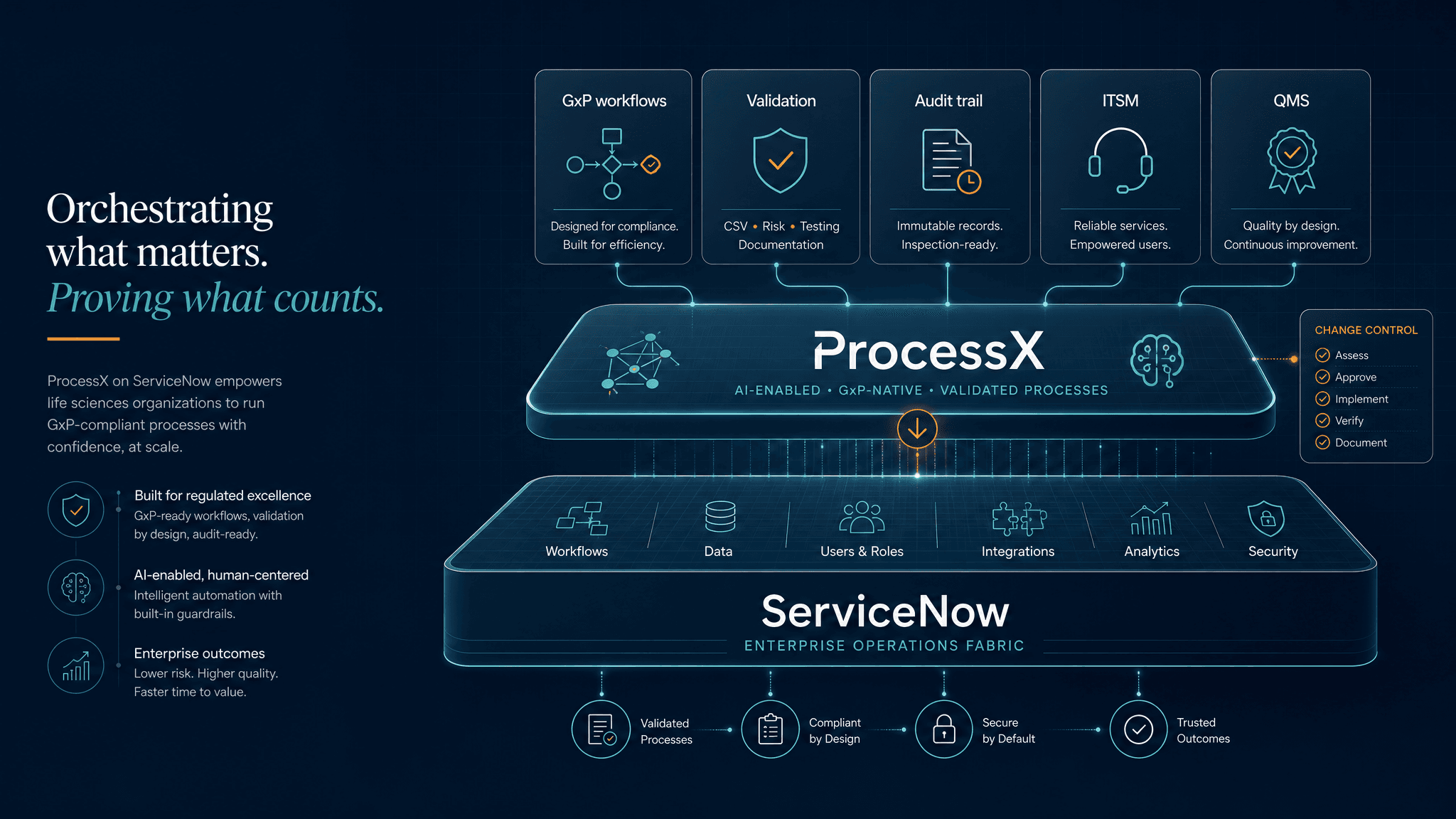
- ProcessX is built around unified workflow management: the page positions ProcessX as a way to manage GxP and non-GxP workflows on ServiceNow instead of maintaining duplicate systems.
- The core pain is operational fragmentation: teams are dealing with siloed data, paper-based processes, complicated validation implementations, and misalignment between IT and Quality.
- The solution set spans regulated operations: Paperless Validation, Regulated ITSM, Application Lifecycle Management, eForms and eLogbooks, Digital Quality, and Adverse Event Intake & Triage.
- The business outcome is faster scale with compliance control: ProcessX extends ServiceNow for IT, Quality, Manufacturing, and Post-Market Surveillance workflows.
The ProcessX solutions page starts with a familiar life sciences problem: organizations maintain separate systems for GxP and non-GxP data because that is how the operating model grew over time. The result is duplicate IT systems, siloed data, fragmented workflows, complicated validation implementations, and too much paper.
That operating model becomes painful when the business needs to scale quickly. IT and Quality may agree that workflow automation is needed, but still stall because generic technology vendors cannot answer detailed regulatory questions. ProcessX addresses that gap by extending ServiceNow's workflow management platform into regulated GxP processes for IT, Quality, Manufacturing, and Post-Market Surveillance.
For USDM, the point is not simply that ServiceNow can move tasks. The point is that ProcessX can help life sciences teams move regulated work with the evidence, control, and data integrity those workflows require.
Unified GxP and non-GxP workflow management
The page frames ProcessX around unified GxP and non-GxP workflow management with ServiceNow for scalable compliance. That distinction matters. Life sciences companies often need one operating platform that can support both controlled regulated work and adjacent non-GxP business processes without forcing teams into separate systems for every risk category.
When that split is not governed well, teams end up with duplicate systems, inconsistent data, manual handoffs, and unclear ownership between IT, Quality, and business process owners. ProcessX gives those groups a shared workflow foundation while preserving the controls needed for regulated use cases.
Six ProcessX solution areas
The ProcessX solutions page highlights six practical solution areas. Each addresses a different part of the regulated operating model.
- Paperless Validation: a cloud-based approach that simplifies validation, keeps teams audit ready, and helps establish a single source of truth.
- Regulated ITSM: ProcessX, built on ServiceNow, helps manage regulated ITSM systems so IT leaders can oversee their functional area and support Quality counterparts.
- Application Lifecycle Management: ALM supports the initial planning and development of software applications, including requirements management, software testing, and change management.
- eForms and eLogbooks: digital forms and logs provide version control and audit trails, enable validation checks that reduce data-entry errors, and support data integrity.
- Digital Quality: new technologies allow organizations to rethink quality processes and align people, processes, and technology around better operational outcomes.
- Adverse Event Intake & Triage: automation can increase accuracy and reduce manual effort in adverse event intake, triage, data entry, and review, even as case volume grows.
Regulated workflows connected on ServiceNow
Validation and lifecycle
- Paperless Validation
- Application Lifecycle Management
- Requirements, testing, and change
Quality and operations
- Digital Quality
- eForms and eLogbooks
- Version control and audit trails
Service workflows
- Regulated ITSM
- Adverse Event Intake
- Triage and review
Paperless Validation as the foundation
Paperless Validation is the first solution called out on the ProcessX page. The promise is straightforward: simplify validation in a cloud-based system and keep the organization audit ready.
That means moving validation away from scattered documents, disconnected trackers, and manual reconciliation. A single source of truth can help teams connect requirements, testing, evidence, approvals, and change history in a way that is easier to operate and easier to defend.
For regulated teams, Paperless Validation also connects to broader USDM Cloud Assurance expectations. Validation is not only an implementation event. Cloud platforms, workflow changes, and system releases keep moving, so the evidence model has to keep moving too.
Regulated ITSM and ALM
Regulated ITSM is where ServiceNow's strength is most obvious, but life sciences teams still need more than standard IT workflow. GxP systems require clear ownership, controlled change, audit trails, quality involvement, access governance, and a defensible relationship between IT execution and Quality oversight.
ProcessX helps bridge that gap by supporting regulated ITSM workflows while giving IT leaders a platform to manage their functional area and support Quality counterparts. That cross-functional bridge is the real value: IT can move work, Quality can see and govern what matters, and the business can avoid paper-driven bottlenecks.
Application Lifecycle Management extends that model into software planning and development. The page calls out requirements management, software testing, and change management as core ALM tasks. In a regulated environment, those activities need to connect to intended use, risk, validation strategy, and release evidence.
eForms, eLogbooks, and data integrity
The page positions eForms and eLogbooks as a practical route to stronger operational data. Version control and audit trails help teams understand what changed and when. Validation checks help reduce data-entry errors. Together, those capabilities support the larger goal of data integrity.
This is where workflow automation has to be careful. Digitizing a paper form is useful only if the resulting record is attributable, legible, contemporaneous, original, accurate, complete, consistent, enduring, and available. ProcessX solution areas such as eForms and eLogbooks are valuable because they can make those controls part of daily execution instead of a separate cleanup exercise.
Digital Quality and adverse event intake
Digital Quality is broader than replacing forms. The page describes new technologies as an opportunity to rethink quality processes and empower people, processes, and technology to achieve transformative business outcomes.
In practical terms, that means quality teams need workflows that help them detect, route, review, and resolve work with better visibility and less manual drag. That same logic applies to Adverse Event Intake & Triage. As adverse event case volume increases, manual intake, triage, data entry, and review become harder to sustain.
ProcessX positions automation as a way to increase accuracy and reduce cost in that intake process. For life sciences teams, the important guardrail is human-reviewed triage and clear evidence around what was received, how it was classified, who reviewed it, and what happened next.
How USDM turns the solutions page into a practical next step
The ProcessX solutions page is short, but it points to a clear operating conversation. Which workflows are creating the most drag? Which ones create the most compliance risk? Which ones need ServiceNow workflow speed but also require GxP evidence, audit trails, validation checks, or Quality oversight?
USDM can help teams map that starting point. The right first workflow may be Paperless Validation, Regulated ITSM, ALM, eForms and eLogbooks, Digital Quality, or Adverse Event Intake & Triage. The right answer depends on where the business is losing time, where evidence is weakest, and where ServiceNow can become a shared operating layer for IT, Quality, Manufacturing, or Post-Market Surveillance.
Explore the USDM ProcessX partner hub for related ProcessX resources, or talk to USDM about which ProcessX solution area should move first.
FAQ: ProcessX Solutions
What is the main purpose of the ProcessX solutions page?
The page presents ProcessX as a way to unify GxP and non-GxP workflow management on ServiceNow. It focuses on reducing duplicate systems, siloed data, paper-based processes, and complicated validation implementations.
Which ProcessX solutions are listed?
The page lists Paperless Validation, Regulated ITSM, Application Lifecycle Management, eForms and eLogbooks, Digital Quality, and Adverse Event Intake & Triage as ProcessX solution areas.
How does ProcessX relate to ServiceNow?
ProcessX leverages ServiceNow's workflow management platform and extends GxP processes for life sciences teams. The page specifically names IT, Quality, Manufacturing, and Post-Market Surveillance as areas where those workflows can apply.
Why does Paperless Validation matter?
Paperless Validation helps simplify validation, keep teams audit ready, and establish a single source of truth. For regulated teams, that can reduce manual reconciliation and make validation evidence easier to operate over time.
How can adverse event intake benefit from ProcessX?
The page positions automation as a way to increase accuracy and decrease costs for adverse event intake. The goal is to reduce manual effort across intake, triage, data entry, and review while preserving appropriate oversight.