Executive takeaway
- Validation is now continuous: cloud platforms, SaaS releases, integrations, and AI-enabled workflows make one-time validation too brittle for modern life sciences teams.
- The lifecycle model connects the work: intended use, requirements, risk, testing, evidence, approvals, change control, and release oversight need to operate as one system.
- Speed and audit readiness can coexist: reusable assets, automated checks, and lifecycle governance reduce manual drag without weakening compliance control.
- The real target is sustainable assurance: a validation model that remains defensible as systems, vendors, workflows, and regulations change.
Why Validation Lifecycle Management Matters
Validation lifecycle management is becoming a critical discipline for life sciences organizations because validation can no longer be treated as a one-time event. Cloud platforms change constantly, regulated systems evolve through updates and integrations, and teams are expected to move faster while still maintaining traceability, control, and inspection readiness.
USDM points to this shift in Computer System Validation Services: From CSV Burden to CSA-Ready Innovation, where the goal is not just to validate a system at implementation, but to manage the full lifecycle from planning and deployment through change control, maintenance, and retirement.
What Validation Lifecycle Management Means
Validation lifecycle management is the structured, ongoing coordination of requirements, risk assessments, validation documentation, testing, approvals, change control, and compliance evidence across the full life of a regulated system. It ensures that systems remain validated as business needs, configurations, vendors, and releases change over time.
USDM’s Automate Validation Across Your Tech Stack white paper frames this as a building-block approach, where reusable validation controls, automated testing, and change management reduce repetitive effort while keeping GxP systems in a controlled state.
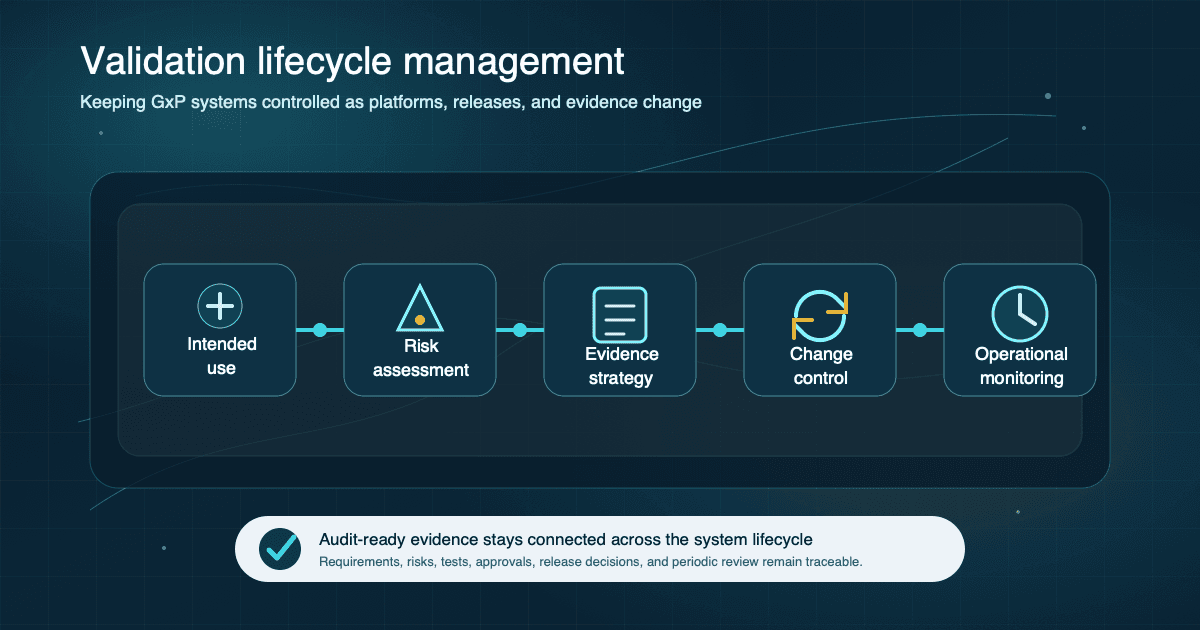
The validation lifecycle operating model
- Intended use: define what the system does, who uses it, what records it creates, and where GxP impact exists.
- Risk assessment: focus validation effort on functions that affect patient safety, product quality, data integrity, and regulated decisions.
- Evidence strategy: decide what requirements, tests, vendor evidence, automated checks, and approvals are needed to defend the system.
- Change control: connect system changes, release impact decisions, deviations, and approvals to the validation baseline.
- Operational monitoring: keep evidence current through vendor releases, configuration changes, integrations, periodic review, and retirement.
Why Traditional Validation Models Break Down
Traditional validation approaches were built for slower-moving environments. Teams could validate a system, archive the documentation, and expect long stretches of stability. That model does not work well in modern life sciences environments where SaaS platforms update frequently, digital ecosystems are interconnected, and business teams need faster implementation cycles.
When validation is managed only as a project milestone, organizations often end up with fragmented records, redundant testing, and reactive remediation work. The result is higher cost, slower change adoption, and more compliance risk.
The Core Benefits of Validation Lifecycle Management
A mature validation lifecycle management approach helps organizations make validation repeatable, scalable, and aligned to real operational risk. It gives Quality, IT, and system owners a common framework for managing change without starting from scratch each time.
Organizations typically benefit by:
- Reducing manual validation effort through reusable assets and automated testing
- Improving audit readiness with organized, current compliance evidence
- Aligning change control, testing, and documentation across teams
- Supporting faster implementations and upgrades without losing control
- Maintaining validated systems more consistently across cloud and on-prem environments
How It Improves Speed and Audit Readiness
One of the strongest advantages of validation lifecycle management is that it supports speed and control at the same time. Instead of treating each release, upgrade, or new implementation as a separate validation mountain, teams can use predefined methods, standardized deliverables, and automated workflows to move more efficiently.
That is visible in Rapid Deployment of Enterprise-Wide GxP Applications, where USDM planned and executed validation lifecycle activities for multiple GxP applications, enabling a startup biotech to become audit ready in 12 weeks and achieve implementation 50 percent faster.
Why Process and Tool Alignment Matter
Validation lifecycle management only works well when process and tooling are aligned. If requirements live in one place, test evidence in another, and change control somewhere else entirely, the lifecycle becomes harder to manage. Teams lose visibility, handoffs become manual, and compliance evidence becomes harder to defend.
USDM highlights that alignment in Integrated GxP Compliance for the Life Sciences Industry, where Cloud Assurance, ProcessX, and the Cloud Assurance Digital Experience are positioned as connected pieces of a broader managed compliance model.
What Good Lifecycle Management Looks Like
Strong validation lifecycle management starts early, with intended use, requirements, and risk clearly defined. It continues through implementation with structured testing and approvals, then extends into operations with change impact assessments, release oversight, updated documents, and ongoing monitoring. The best programs are risk-based, repeatable, and visible across functions.
USDM’s Introduction to Software Validation lays out the underlying components clearly, including validation planning, requirements, risk assessment, qualification testing, traceability, and summary reporting as part of a defensible validation structure.
Real-World Validation Lifecycle Outcomes
The value becomes especially clear in large or complex environments. When lifecycle management is done well, organizations reduce rework, shorten validation timelines, and make future upgrades less painful.
For example, in Comprehensive SAP Validation Effort, Time Reduced by Over 50%, USDM created a repeatable ALM-based validation approach that reduced the validation schedule and effort by more than 50 percent for subsequent site implementations while mitigating upgrade risk.
Common Mistakes to Avoid
Organizations often struggle when validation lifecycle management is treated as documentation overhead instead of an operating discipline. The most common mistakes are predictable and expensive.
Common mistakes include:
- Treating validation as a one-time project instead of a managed lifecycle
- Separating change control from validation planning and test strategy
- Over-documenting low-risk activities while under-managing high-risk changes
- Relying on manual coordination between Quality, IT, and business owners
- Failing to design reusable validation assets for future releases and upgrades
Building a Sustainable Validation Model
Validation lifecycle management is no longer optional for modern life sciences organizations. It is the practical way to keep regulated systems compliant while supporting digital transformation, faster releases, and lower manual burden.
The organizations that do this well will not just pass audits more easily. They will also move faster, reduce validation waste, and create a more sustainable model for managing regulated technology over time.
Validation Lifecycle Management FAQ
What is validation lifecycle management?
Validation lifecycle management is the ongoing process of managing requirements, risk, testing, approvals, change control, and compliance evidence across the full life of a regulated system. It keeps validation current after implementation, especially as cloud platforms, SaaS releases, integrations, and business workflows change.
How is validation lifecycle management different from computer system validation?
Computer system validation proves that a regulated system performs as intended. Validation lifecycle management extends that discipline beyond the initial project, connecting validation evidence to change control, release management, periodic review, deviations, vendor updates, and retirement so the system remains controlled over time.
Why does validation lifecycle management matter for SaaS and cloud systems?
SaaS and cloud systems change frequently through vendor releases, patches, configuration updates, and integrations. Without lifecycle management, each change can create evidence gaps or manual rework. A lifecycle model helps teams assess impact, reuse validation assets, document decisions, and maintain audit readiness without slowing every release.
What should a mature validation lifecycle include?
A mature lifecycle should include intended-use documentation, risk assessment, requirements traceability, test evidence, approval workflows, change impact decisions, release records, deviation handling, vendor oversight, periodic review, and retirement planning. The level of effort should be proportional to GxP impact and business risk.
How can life sciences teams reduce validation lifecycle burden?
Teams can reduce burden by standardizing validation methods, reusing approved assets, automating repeatable checks, aligning change control with release management, and tracking evidence gaps continuously. The goal is not less control; it is less duplicated effort and a more defensible operating model.
Ready to Strengthen Your Validation Lifecycle?
If validation work is slowing releases, creating audit scrambles, or depending too heavily on a few internal experts, the lifecycle model probably needs attention.
Talk to USDM about building a validation lifecycle model that keeps regulated systems audit ready without slowing down the business.