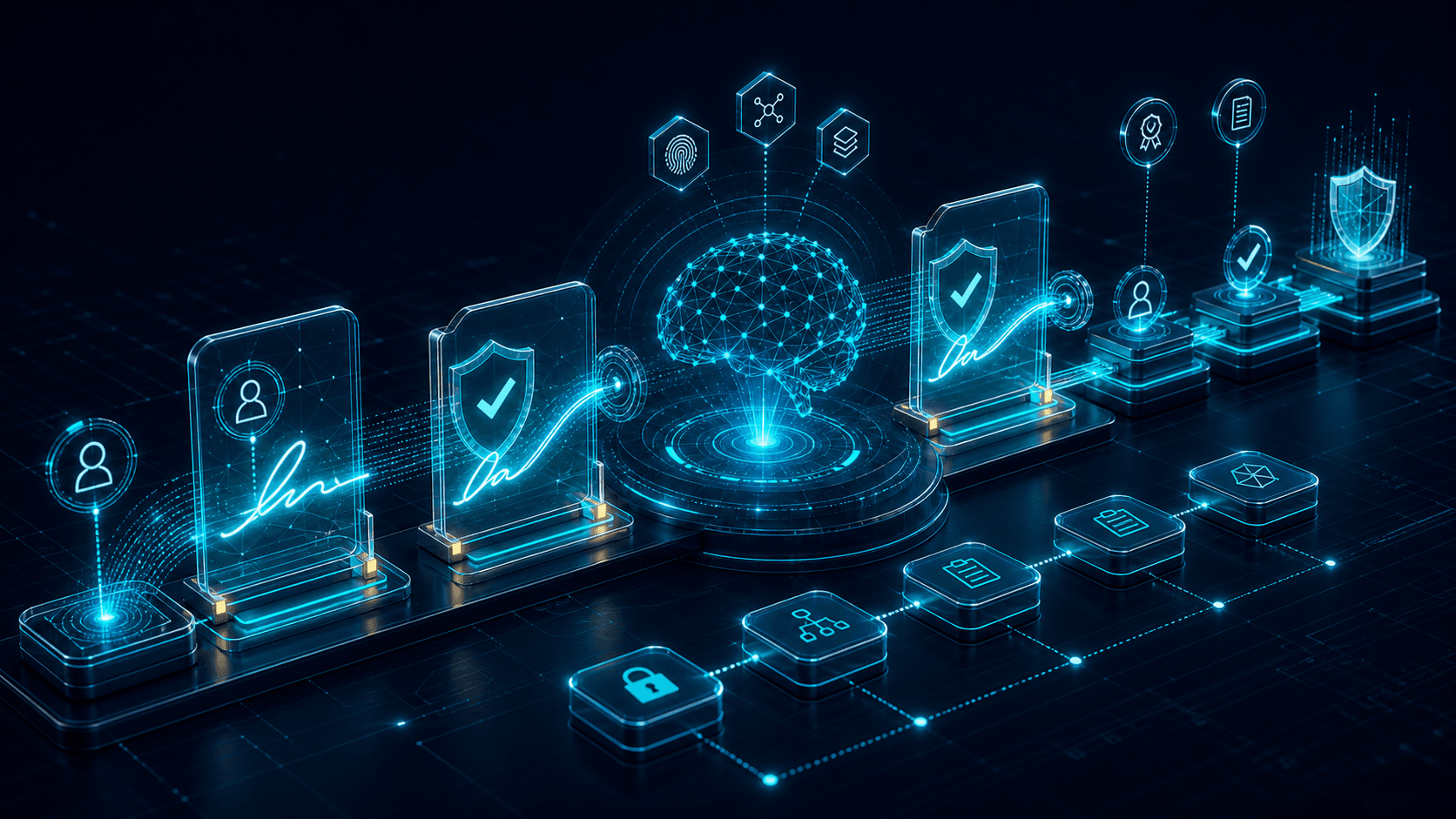
Learn how artificial intelligence (AI) and machine learning contribute to secure and compliant signing processes in the life sciences industry.
Summary
Electronic signatures in regulated life sciences must satisfy FDA 21 CFR Part 11 and EU Annex 11 — meaning every signature has to be authenticated, permanently linked to its record, and fully traceable. AI and machine learning help meet those expectations by analyzing behavior to flag suspicious activity, strengthening audit trails, authenticating users, and using predictive analytics to stay ahead of evolving regulations. This article explains where AI adds compliance value across the eSignature lifecycle and how USDM helps you keep those systems continuously compliant.
Regulatory compliance means that your products, systems, and services are created and maintained in a quality-first environment. It demonstrates to stakeholders and the public that your products are safe and effective. It also helps your organization avoid fines, penalties, and other repercussions due to non-compliance.
Discover How AI Contributes to Regulatory Compliance
Life sciences organizations that use electronic signatures (eSignatures) must adhere to U.S. Food and Drug Administration (FDA) 21 CFR Part 11 and European Union (EU) Annex 11 guidelines.
The intent of 21 CFR Part 11 is to maintain accountability and traceability of your electronic records, including eSignatures. It helps ensure that:
- System access is restricted to authorized individuals
- The system is able to detect and report attempts of unauthorized use
- Audit trails are built into the system
Annex 11 states that electronic signatures are expected to:
- Have the same impact as hand-written signatures
- Be permanently linked to their respective record
- Include the time and date they were obtained
To help support these requirements and expectations and make compliance seamless and effective, AI algorithms analyze behavior and patterns to detect suspicious activities. Machine learning algorithms are trained on vast amounts of historical data that enable a system to detect tampering or forgery.
Meeting Part 11 and Annex 11 is not a one-time event. The same controls that make an eSignature valid the day it is captured must hold up across the entire record lifecycle. For a deeper look at the underlying rule, see USDM's overview of 21 CFR Part 11 compliance.
Learn About AI's Role in Audit Trails and Logging
An audit trail logs access to a system and what operations were performed by that user. When records are created, modified, or deleted, 21 CFR Part 11 requires that you know who did it and for what reason. It also requires that records are retained and are traceable by way of timestamps and version history.
To enhance security and help prevent unauthorized access to your eSignature system, AI-powered features like face or voice recognition can be used to authenticate users. Machine learning algorithms can also be used to detect suspicious activity.
Because audit trails and signatures are only as trustworthy as the records they protect, strong data integrity practices are foundational to defensible eSignature compliance.
Where AI Reinforces eSignature Compliance
- Authentication: AI-powered face or voice recognition helps confirm that the right authorized individual is signing.
- Anomaly detection: Machine learning analyzes behavior and patterns to flag suspicious activity, tampering, or forgery.
- Audit trails and logging: AI helps surface who acted, what they did, and when — supporting traceability and retention requirements.
- Predictive analytics: Machine learning, historical data, and statistical algorithms help anticipate regulatory and operational changes before they become risks.
Foster a Culture of Security Awareness
While AI does its part to protect against cybersecurity threats and unauthorized access, it’s important to train your employees on compliance requirements to foster a culture of security awareness. Being familiar with information security (IS) policies and best practices and recognizing potential risks and threats helps keep your organization more secure.
When you collaborate with cybersecurity experts at USDM Life Sciences, you’ll have access to the knowledge and experience that helps your organization achieve FDA and other regulatory compliance expectations for good cybersecurity practices. The experts will also ensure that you meet standards like the General Data Protection Regulation (GDPR) in the EU and the Health Insurance Portability and Accountability Act (HIPAA) in the U.S.
AI does its part to protect against cybersecurity threats and unauthorized access, but a culture of security awareness — trained people who recognize risk — is what keeps compliant systems compliant.
Stay Ahead of Evolving Regulatory Standards
Regular audits and assessments ensure ongoing compliance with industry regulations. Continuous monitoring and periodic reassessment of validation methods are necessary to address technological advancements, comply with evolving regulatory standards, and maintain the integrity of electronic signatures throughout their lifecycle.
Another way that AI helps life sciences organizations stay ahead of evolving regulatory standards is through predictive analytics, which uses machine learning, historical data, and statistical algorithms. The result is the ability to anticipate the likelihood of regulation changes—and to predict certain customer behaviors, market trends, or equipment failures.
As organizations introduce AI into validated and GxP environments, a deliberate approach to AI governance and compliance keeps these tools auditable, defensible, and aligned with regulatory expectations.
Read the white paper, Enhancing Security and Ensuring Data Integrity in eSignature Solutions, which identifies ways to simplify regulatory compliance for your organization.
How USDM Can Help
To simplify the validation burden for your IT teams, USDM’s Cloud Assurance as a Platform service maintains the continuous compliance of your GxP systems and environments. USDM executes automated regression testing and scripts on a monthly or weekly basis, or whenever releases are introduced. Where relevant, AI tools are used to support risk identification and mitigation activities.
We also ensure that AI-enhanced Software-as-a-Service (SaaS) solutions adapt to changes in technology and remain compliant with regulatory standards, including compliance with informed consent and data privacy regulations.
To reinforce your regulatory compliance, we assess vendor software and quality management system maturity using a disciplined approach to third-party risk management. After we identify and remediate technical, process, personnel, or regulatory gaps, we help your organization leverage vendor activities to significantly reduce your compliance and maintenance burden.
For organizations exploring how AI and intelligent agents can extend these compliance capabilities, USDM's agentic AI team helps life sciences companies adopt automation responsibly within validated, regulated environments.
FAQ: AI and eSignature Compliance in Life Sciences
What regulations govern eSignatures in life sciences?
Life sciences organizations that use electronic signatures must adhere to U.S. FDA 21 CFR Part 11 and EU Annex 11. These frameworks require that eSignatures are restricted to authorized users, permanently linked to their records, time- and date-stamped, and supported by built-in audit trails.
How does AI help with eSignature compliance?
AI algorithms analyze behavior and patterns to detect suspicious activity, and machine learning models trained on historical data can detect tampering or forgery. AI-powered authentication such as face or voice recognition helps confirm signer identity, while predictive analytics help organizations anticipate regulatory and operational changes.
What role do audit trails play under 21 CFR Part 11?
An audit trail logs who accessed a system and what operations they performed. When records are created, modified, or deleted, 21 CFR Part 11 requires that you know who did it and why, and that records are retained and traceable through timestamps and version history.
Is AI alone enough to keep eSignature systems secure?
No. While AI protects against many cybersecurity threats and unauthorized access, organizations also need to train employees on compliance requirements and foster a culture of security awareness. Familiarity with information security policies and recognition of potential risks help keep the organization secure.
How does USDM help maintain continuous compliance?
USDM's Cloud Assurance as a Platform service maintains the continuous compliance of GxP systems and environments through automated regression testing and scripts run on a monthly or weekly basis or whenever releases are introduced. USDM also assesses vendor software and quality management system maturity, then remediates technical, process, personnel, or regulatory gaps.
Keep Your eSignature Systems Continuously Compliant
USDM's reputation is built on bringing clarity and action to the interplay of technology and regulations. We have more than 23 years of experience in the life sciences industry and stand ready to help you maintain continuous compliance. Contact us to get started today.