
Enterprise AI is not one tool. It is an ecosystem.
Life sciences organizations are moving quickly from AI experimentation to practical enterprise adoption. The conversation is no longer only about which large language model is best, which chatbot is most impressive, or which cloud provider has the strongest AI services. Those choices matter, but they are only pieces of a larger enterprise AI operating model.
For regulated organizations, the harder question is this: how do we make AI useful across the business while keeping it connected to trusted enterprise knowledge, governed by existing permissions, aligned to approved sources, and practical for the teams doing the work?
That is where the enterprise AI stack needs to be viewed as an ecosystem.
Azure, Google Cloud, OpenAI, Microsoft 365, Google Workspace, Salesforce, ServiceNow, Veeva, Box, SharePoint, and other enterprise platforms each play an important role. Glean fits into that ecosystem as a work AI platform that helps connect enterprise knowledge, search, assistants, agents, governance, and business workflows.
The point is not that Glean replaces the rest of the stack. It does not. The better framing is that Glean can help organizations make the stack more usable, more connected, and more governed for day-to-day work.
Executive view
- Cloud and model platforms still matter: Azure, Google Cloud, OpenAI, Gemini, Claude, and other providers remain foundational parts of the AI architecture.
- Enterprise systems remain the source of work context: business knowledge lives across Microsoft 365, Google Workspace, Salesforce, ServiceNow, Veeva, Box, SharePoint, and other systems.
- Glean fits as a work AI layer: its role is to connect knowledge, permissions, search, assistants, agents, and workflow context across the environment.
- Regulated adoption still needs governance: life sciences organizations need approved sources, access controls, review models, validation strategy, and operating discipline around AI use cases.
The enterprise AI stack has several layers
A practical way to understand enterprise AI is to separate the stack into layers.
At the infrastructure and platform layer, organizations rely on providers such as Microsoft Azure and Google Cloud for cloud services, identity, security, data infrastructure, AI tooling, model access, and marketplace procurement. These platforms are foundational. They provide the technical environment in which enterprise systems, data, and AI capabilities can operate at scale.
At the model layer, organizations may use OpenAI, Azure OpenAI, Google Gemini, Anthropic Claude, Amazon Bedrock models, or other specialized models. These models provide language understanding, generation, reasoning, summarization, classification, and agentic capabilities. Model choice is important, and in many cases organizations will want flexibility rather than a single-model strategy.
At the enterprise systems layer, business knowledge lives across many platforms: Microsoft 365, Google Workspace, SharePoint, Box, Salesforce, ServiceNow, Veeva, Jira, Confluence, email, document repositories, quality systems, regulatory systems, commercial systems, and custom applications. In life sciences, this information is especially complex because it includes regulated content, controlled processes, audit requirements, validation expectations, and role-based access considerations.
At the governance layer, organizations need approved sources, permissions, access controls, auditability, human review, data protection, and policy-driven workflows. This is not optional in regulated industries. AI that produces impressive answers but cannot respect enterprise controls is not ready for broad adoption in a GxP-conscious environment.
At the user and workflow layer, employees need practical ways to search, ask, create, analyze, automate, and take action without jumping between disconnected tools. This is where enterprise AI becomes valuable: not in a demo, but in the flow of actual work.
Glean fits across these layers as an enterprise work AI platform.
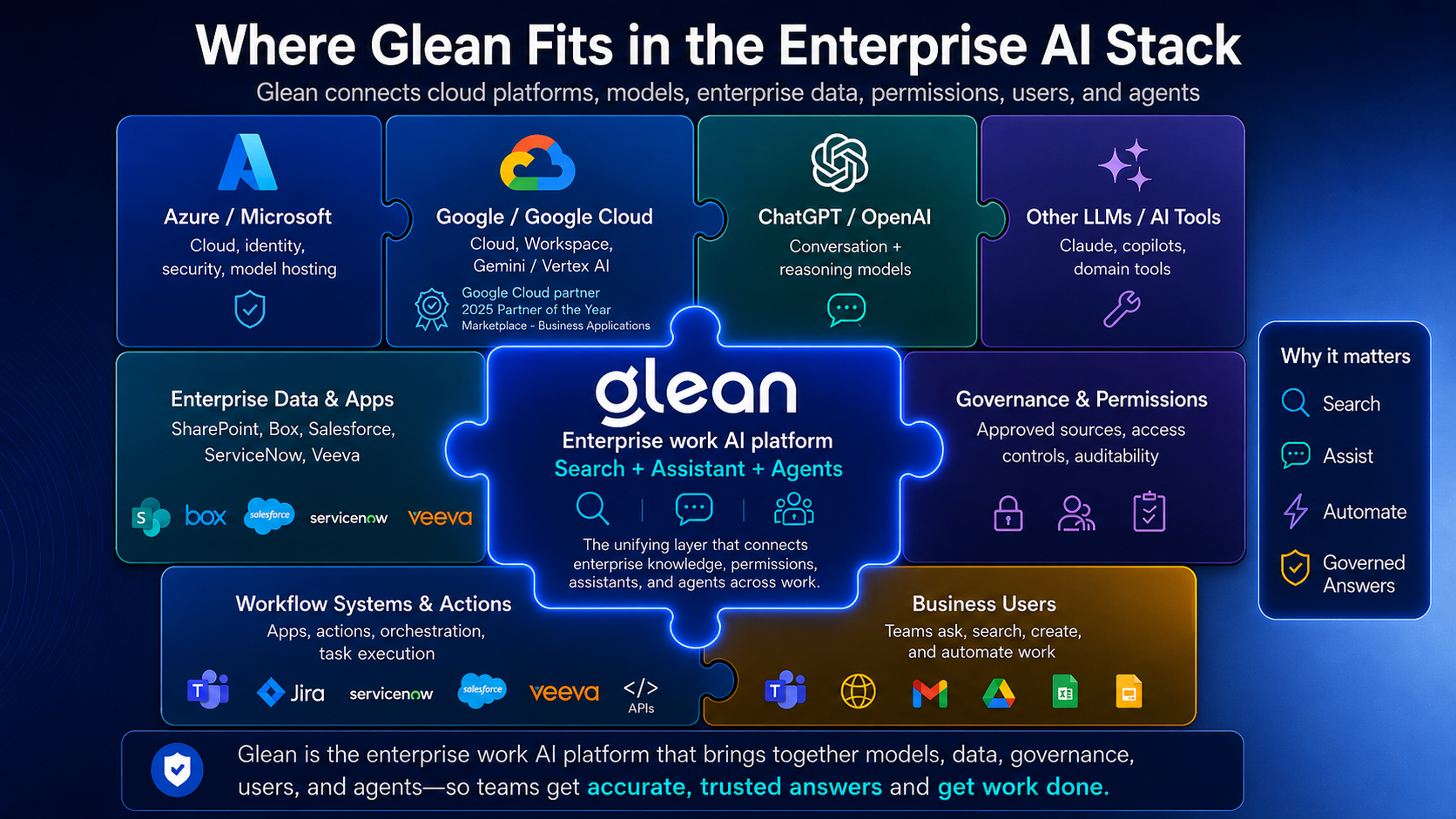
Glean’s role: a work AI layer across knowledge, permissions, users, and agents
Glean is best understood as a horizontal work AI platform. It is not just an enterprise search tool, and it is not just a chatbot. Its value is in bringing together enterprise context, governed search, AI assistance, and agents across the systems people already use.
That distinction matters.
Many organizations already have strong investments in Microsoft, Google, Salesforce, ServiceNow, Veeva, Box, and other enterprise platforms. They also have existing relationships with cloud and model providers. Glean does not need to displace those investments to create value. Instead, it can help make those investments more accessible and actionable by connecting enterprise knowledge to AI experiences that are permission-aware and work-oriented.
In practical terms, Glean helps answer questions such as:
- Where does the latest approved information live?
- Which source should I trust?
- Can I ask a question across multiple systems without manually searching each one?
- Can an AI assistant generate an answer that is grounded in enterprise content?
- Can agents take action across workflows while respecting enterprise permissions and controls?
- Can teams move from finding information to completing work?
These are the problems that emerge when enterprise AI moves beyond isolated pilots.
Why Glean is not simply “another AI tool”
A common mistake in AI strategy is to compare every product as if each one belongs in the same category. That leads to oversimplified questions such as, “Is this better than ChatGPT?” or “Does this replace Copilot?” or “Is this competing with Azure?”
Those questions can be useful in narrow buying decisions, but they are not sufficient for enterprise architecture.
Azure and Google Cloud are cloud and AI platforms. OpenAI, Gemini, Claude, and other models provide reasoning and generation capabilities. Microsoft 365 and Google Workspace are productivity ecosystems. Salesforce, ServiceNow, and Veeva are systems of record and workflow. Box and SharePoint are major content repositories. Each has a role.
Glean’s role is different. It operates as a work AI layer that connects enterprise knowledge and context to search, assistants, agents, and workflows. In that sense, it is not primarily a replacement for the ecosystem. It is a connective layer that can help the ecosystem work better for employees.
The better question is not “Glean versus the rest of the stack.” It is “where does Glean fit so the rest of the stack becomes more usable, governed, and connected?”
Why this matters in life sciences
Life sciences companies have a specific challenge with enterprise AI. They operate in an environment where trust, quality, regulatory expectations, security, and traceability matter. A general-purpose AI experience may be useful for brainstorming or drafting, but enterprise adoption requires more than convenience.
AI must be grounded in approved and relevant sources. It must respect access rights and permissions. It must support auditability and review where appropriate. It must avoid turning outdated, uncontrolled, or informal content into operational guidance. It must support the way regulated teams actually work across quality, regulatory, clinical, safety, manufacturing, medical, commercial, IT, and corporate functions.
This is why enterprise context is so important. The question is not only whether a model can generate an answer. The question is whether the answer is grounded in the right enterprise information, available to the right user, under the right controls, and useful for the work being performed.
For life sciences, this is the difference between AI as a productivity novelty and AI as an enterprise capability.
Glean and the partner ecosystem
Most life sciences organizations do not operate in a one-vendor, one-cloud, one-model, or one-application environment. A customer may use Microsoft 365 and Azure, Google Cloud and Google Workspace, Salesforce for commercial operations, ServiceNow for enterprise workflow, Veeva for regulated life sciences processes, Box or SharePoint for content, and multiple AI models for different use cases.
That reality should shape AI strategy.
Glean’s value is strongest when it is positioned as part of this ecosystem. It can connect to enterprise applications and knowledge sources, work with different model and cloud strategies, and support governed AI experiences for employees. It is not the only piece, and it should not be positioned as such. But it can be an important piece for organizations trying to make enterprise AI usable across many systems.
For USDM, this ecosystem view is important. Regulated companies should not adopt AI by chasing isolated tools. They need an architecture, a governance model, validated use cases, change management, and a path from experimentation to controlled operational use.
Glean can be part of that path.
Search, assistant, and agents: three practical work patterns
One useful way to understand Glean’s role is through three work patterns: search, assistant, and agents.
Search
Search is the foundation. Employees need to find the right information across fragmented systems. In large enterprises, knowledge is distributed across repositories, applications, teams, chats, tickets, documents, and records. Search becomes more valuable when it understands enterprise context and permissions.
Assistant
Assistant capabilities build on search. Employees want to ask questions, summarize information, draft content, compare sources, and generate useful outputs. The assistant experience becomes more valuable when it is grounded in company knowledge rather than relying only on generic web or model knowledge.
Agents
Agents extend this further. Agents can help execute repeatable work, coordinate tasks, trigger workflows, and support business processes. But agents require governance. Without controls, agents can create risk faster than value. In regulated environments, agentic AI needs clear boundaries, approved systems, human oversight where required, and traceable behavior.
Three work patterns Glean can support
- Search: find the right information across fragmented systems while respecting access permissions.
- Assistant: ask questions, summarize content, compare sources, and draft outputs grounded in enterprise knowledge.
- Agents: coordinate repeatable work and business workflows within governed boundaries and review models.
This is why Glean’s positioning as a work AI platform matters. The combination of search, assistant, and agents is more valuable when it is connected to enterprise context and governed by enterprise controls.
How USDM helps make the ecosystem work
The opportunity is not simply to deploy another AI platform. The opportunity is to design an enterprise AI operating model that works in regulated life sciences.
That operating model still has to handle the work around Glean: data strategy, source quality, platform architecture, governance, validation, training, risk assessment, and use-case decisions. If enterprise content is duplicated, outdated, poorly governed, or misaligned across systems, AI will surface those problems faster. If teams have not defined which workflows can be automated, which require human review, and which should stay out of scope, agentic AI can create risk faster than value.
This is where Glean’s role and USDM’s role come together. Glean can be an important work AI layer across the enterprise stack, but successful adoption depends on the surrounding architecture, controls, operating procedures, and change management that make the platform useful in a regulated environment.
USDM Life Sciences helps organizations think through questions such as:
- Which AI use cases are appropriate for search, assistant, or agents?
- Which sources should be approved for AI grounding, and which should be excluded?
- How should data quality, content ownership, and source-system governance be handled before AI scales?
- How should permissions, auditability, and human review be handled?
- Where do cloud, model, application, and work AI platforms fit in the architecture?
- How should organizations evaluate AI outputs for accuracy, traceability, and intended use?
- Which workflows can be automated safely, and which require quality, compliance, or business review?
- How should AI adoption be governed across quality, regulatory, clinical, manufacturing, safety, commercial, and corporate functions?
- How do we create measurable value without increasing compliance risk?
This is where the ecosystem view becomes practical. Glean may be one important component, but successful adoption depends on how it is integrated into the larger enterprise environment.
A balanced view
Glean fits well in the enterprise AI stack because it addresses a real gap: the need for a governed, enterprise-aware work AI layer that connects knowledge, permissions, users, assistants, and agents across many systems.
It should not be oversold as a replacement for cloud platforms, model providers, or enterprise applications. It is better understood as a platform that can help bring those investments together in the flow of work.
For life sciences organizations, that distinction is critical. AI adoption will not be won by isolated pilots or uncontrolled tool sprawl. It will be won by connecting the right platforms, the right data, the right controls, the right use cases, and the right operating model.
Glean can play a meaningful role in that architecture.
USDM’s role is to help life sciences organizations implement AI in a way that is practical, governed, compliant, and connected to business outcomes.
The future of enterprise AI is not one tool. It is an ecosystem. The companies that succeed will be the ones that make that ecosystem work.
Talk to USDM about where Glean fits in your life sciences AI architecture.
FAQ: Where Glean fits in enterprise AI
Does Glean replace cloud platforms or model providers?
No. Glean is better understood as a work AI layer that connects enterprise knowledge, search, assistants, agents, and workflows. Cloud platforms, model providers, and systems of record still provide essential infrastructure, reasoning capabilities, and source-system context.
Why does Glean matter for life sciences organizations?
Life sciences teams need AI experiences that are grounded in approved enterprise knowledge, respect permissions, and fit controlled ways of working. Glean can help connect knowledge across fragmented systems, while governance and implementation discipline determine whether those capabilities are appropriate for regulated use cases.
How should companies decide where to start?
Start with use cases where knowledge access creates clear business value and the governance boundary is understandable. Search and assistant patterns are often easier starting points than autonomous agents, especially when regulated content, quality records, or GxP workflows are involved.
What does USDM add to a Glean implementation?
USDM helps life sciences organizations translate Glean into a governed operating model: use-case selection, data and source approval, permissions, validation strategy, human review, change management, training, and adoption across regulated functions.