Executive takeaways
- Life sciences contact centers are regulated front doors: adverse events, complaints, clinical support, field service, and regulatory inquiries need compliant routing and evidence.
- CCC is built on ServiceNow CSM: Compliant Contact Center is a pre-validated GxP-ready workflow solution powered by ProcessX.
- AI helps triage, but controls still matter: case classification, duplicate detection, and risk scoring must remain explainable and reviewable.
- The impact is operational and regulatory: faster handling, faster triage, and cleaner evidence can reduce manual burden while improving audit readiness.
Compliant Contact Center is a modern digital front door for regulated life sciences work. The premise is simple: contact center cases are not always ordinary customer service interactions. Some become safety, quality, regulatory, clinical, or field service workflows.
That is why speed alone is not enough. A life sciences contact center needs intake, triage, escalation, documentation, and reporting workflows that can stand up to review.
What Compliant Contact Center is
USDM Compliant Contact Center, or CCC, is described as a pre-validated GxP-ready workflow solution built on ServiceNow Customer Service Management and powered by ProcessX. It is designed to unify intake, triage, escalation, regulatory submissions, and documentation into a single audit-ready workflow.
CCC can separate GxP and non-GxP data, apply appropriate controls, and keep workflows aligned with 21 CFR Part 11 expectations without forcing customers to validate an entire ServiceNow instance for every use case.
How cases move through CCC
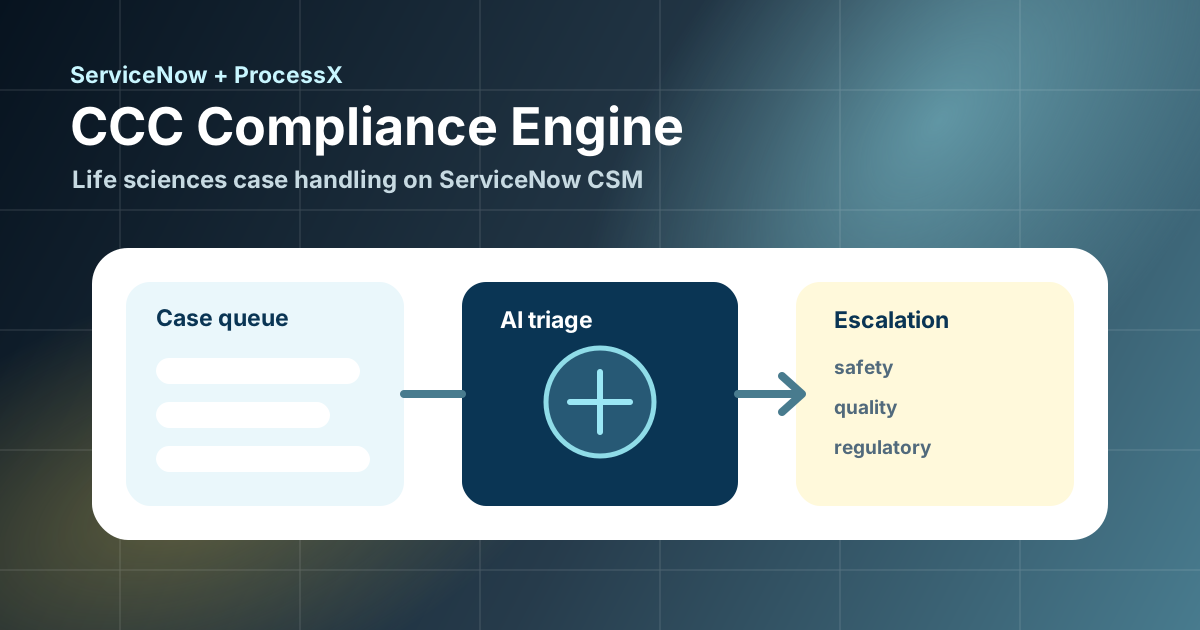
Cases can arrive through email, phone, chatbot, portal, SMS, or another system. CCC uses AI-assisted classification to determine what kind of event has arrived, whether it is GxP-relevant, and which workflow should handle it.
On the backend, integrations with systems such as Argus, Veeva, Oracle, and QMS platforms may be needed. That matters because contact center work often needs to hand off to safety, quality, regulatory, manufacturing, supply chain, clinical, or commercial teams.
A compliant workflow engine for regulated cases
Channels
- Email and phone
- Portal and chatbot
- SMS and systems
AI triage
- Classify event
- Detect duplicates
- Score risk
Regulated action
- Safety or quality review
- Audit trail
- Reporting evidence
Where CCC delivers impact
CCC can support adverse event intake and reporting, product complaints and CAPA, clinical site onboarding and trial support, equipment qualification and lab operations, vendor oversight and third-party risk, and cold chain or field service workflows.
It also cites reported outcomes: 58% faster case handling, 40 to 60% faster triage, 30 to 40% of non-reportable events filtered automatically, $1.5M+ saved annually through reduced manual intake labor, 50% faster regulatory submissions, and $3M to $5M in avoided audit penalties. Those are directional outcomes and should be evaluated against each organization's baseline.
Why USDM and ServiceNow fit together
USDM combines life sciences compliance experience, ProcessX, CSA-aligned validation, validation lifecycle management, and AI governance with ServiceNow's enterprise workflow platform, unified data model, AI capabilities, and omnichannel architecture.
The right architecture gives agents a guided workflow while giving Quality, Safety, Regulatory, and IT the evidence they need. That is the real value of CCC: not just a faster contact center, but a controlled operating model for regulated case work.
Explore Compliant Contact Center for Life Sciences, visit the ProcessX partner hub, or talk to USDM about a CCC workflow demo.
FAQ: USDM Compliant Contact Center on ServiceNow
What is USDM Compliant Contact Center?
It is a ServiceNow Customer Service Management workflow solution powered by ProcessX for regulated life sciences intake, triage, escalation, documentation, and reporting.
Which teams can use CCC?
CCC can support safety, quality, regulatory, clinical, field service, supply chain, commercial, and IT teams when their intake workflows need GxP controls, traceability, or regulated escalation.
How does AI fit into CCC?
AI can assist with classification, duplicate detection, triage, and risk scoring. In regulated use, those recommendations still need appropriate controls, auditability, and accountable human review.
Does CCC replace safety or quality systems?
No. CCC is positioned as the regulated intake and workflow engine. It may integrate with safety, quality, and regulatory systems so that each case moves into the right downstream process with cleaner evidence.