Executive takeaways
- Paperless validation reduces compliance drag: electronic records, routed approvals, compliant e-signatures, audit trails, and connected evidence help validation teams move faster without losing control.
- Automation keeps validation current: test automation and regression testing can shorten execution cycles and help teams verify critical workflows after releases, enhancements, and configuration changes.
- ALM and VLM belong together: application lifecycle management and validation lifecycle management help teams connect requirements, risks, testing, traceability, approvals, and release decisions.
- Cloud Assurance extends the operating model: ProcessX and USDM Cloud Assurance help regulated teams manage vendor releases, validation evidence, and ongoing compliance across SaaS and GxP platforms.
Paper-based validation has never been famous for speed. In life sciences, the work is necessary: teams need evidence that GxP systems, processes, and equipment are fit for intended use. But when that evidence lives in binders, spreadsheets, email threads, disconnected test records, and manual approval queues, validation becomes harder to operate and harder to defend.
ProcessX by USDM helps life sciences organizations trade document-heavy validation activity for governed digital workflows. The goal is not to make compliance casual. The goal is to keep requirements, tests, approvals, audit trails, and lifecycle decisions connected while the work is happening.
Why paperless validation matters
Paperless validation supports Good Automated Manufacturing Practice principles, 21 CFR Part 11 expectations, Annex 11 considerations, and broader GxP documentation needs by moving validation work into controlled electronic workflows. Validation plans, protocols, test cases, results, reports, approvals, and signatures can be created, routed, reviewed, retained, and retrieved without reconstructing the story later.
That matters because validation is not a single document. It is a lifecycle of decisions. Teams need to know what was required, what changed, what was tested, what passed, what failed, how exceptions were handled, who approved the outcome, and whether the system remains controlled after go-live.
For related foundations, review paperless validation and test automation, GxP validation processes, and 21 CFR Part 11 compliance.
Modernized document management
Modern validation starts by removing the fragmentation. ProcessX helps teams manage validation artifacts electronically so plans, protocols, test scripts, reports, and approvals stay in a controlled workflow. That gives Quality, IT, validation, and business process owners a shared operating layer instead of another disconnected document repository.
Electronic document management also improves inspection readiness. Teams can retrieve current records, trace decisions, and show who reviewed and approved the work without combing through local files or inboxes. The practical benefit is simple: the validation package becomes easier to understand because the work and the evidence stay connected.
Connect validation work, automated testing, and lifecycle evidence
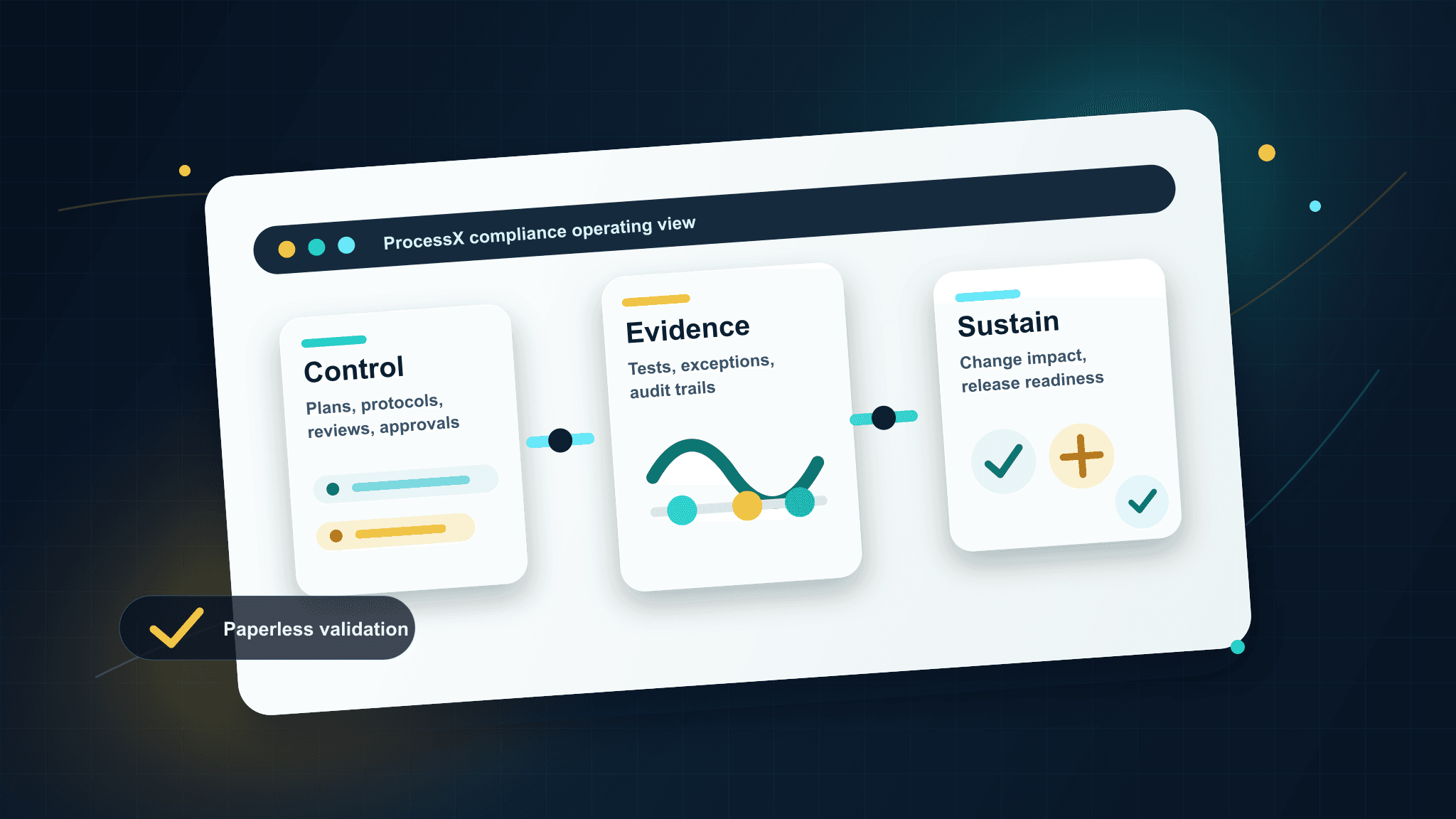
Control the work
- Plans and protocols
- Approval routing
- Electronic signatures
Automate evidence
- Test execution
- Regression checks
- Audit trails
Sustain compliance
- Traceability
- Change impact
- Cloud Assurance
Automated workflows and compliant e-signatures
Manual routing creates delay and ambiguity. Automated workflows help route approvals, reviews, signatures, and document updates to the right owners at the right time. That reduces decision latency and makes accountability clearer.
For regulated use, electronic signatures need more than convenience. Teams need identity controls, signature meaning, record linkage, audit trails, and procedures that support the intended use. ProcessX helps make those controls part of the workflow rather than a separate after-the-fact activity.
Audit trails and data integrity
Data integrity depends on trustworthy records. A paperless validation system should capture who did what, when they did it, what changed, and why the decision was approved. Those audit trails help teams maintain traceability and support ALCOA+ expectations for attributable, legible, contemporaneous, original, accurate, complete, consistent, enduring, and available records.
That is why digital validation should be designed with data integrity in life sciences in mind. The value is not only faster execution. The value is a clearer evidence trail that can survive audits, inspections, vendor reviews, and internal quality events.
Test automation changes the execution cycle
Validation teams often spend weeks executing repetitive tests and documenting results. ProcessX can help shorten that cycle through automated testing and regression testing for GxP workflows and applications. Scripts can be executed after releases, enhancements, and configuration changes so teams have current evidence about whether critical functions still perform as intended.
Automation does not remove governance. Automated tests need controlled scripts, expected results, exception handling, review, and traceability to requirements. The advantage is that high-value testing can happen more consistently, with less manual chasing and stronger visibility into validation cycle status.
ProcessX compliance capabilities to evaluate
- Validation artifacts: electronic plans, protocols, test cases, reports, traceability, and approval records.
- Workflow routing: automated review, approval, e-signature, exception, and release decision workflows.
- Testing model: automated test execution, regression testing, controlled scripts, and visible test status.
- Risk basis: impact assessments, Computer Software Assurance alignment, and risk-based documentation depth.
- Sustainment: change control, vendor release management, periodic review, and USDM Cloud Assurance support.
Application and validation lifecycle management
Application lifecycle management and validation lifecycle management work best when they are connected. ALM manages the application changes, releases, requirements, and technical lifecycle. VLM manages the validation evidence, risk decisions, testing, traceability, and approval lifecycle. Regulated teams need both views to avoid releasing systems before required approvals and evidence are complete.
ProcessX supports that connection by helping teams create and approve validation plans, maintain traceability matrices, manage risk-based requirements, sustain the validated state, prepare for audits, and establish a single source of truth. For more detail, review validation lifecycle management for life sciences teams.
Process optimization across GxP systems
ProcessX supports paperless validation across a range of GxP and quality-adjacent systems, including enterprise GxP applications, analytical instrument systems, manufacturing equipment and software, automation systems, and ServiceNow-based regulated workflows.
The common thread is intended use. If a system supports regulated records, quality decisions, manufacturing activity, laboratory work, clinical operations, or compliance workflows, teams need a defensible approach to validation and sustainment. ProcessX helps bring that work into a controlled workflow model instead of leaving every system to invent its own evidence path.
Cloud Assurance for vendor and validation management
SaaS release velocity creates a recurring validation problem. Vendors change platforms frequently, and regulated teams need to understand what changed, whether it affects GxP use, which scripts or requirements need updates, and what evidence is required before release.
USDM Cloud Assurance complements ProcessX by helping teams manage ongoing vendor releases, validation deliverables, risk assessments, regulatory applicability assessments, change control, GxP system inventory, and automated script updates. Together, ProcessX and Cloud Assurance help organizations maintain the validated state without treating each vendor update as a fire drill.
Make validation easier to operate
If your organization is still heavily paper-based, ProcessX can help accelerate the move toward paperless validation, automated testing, and continuously compliant workflows. The best outcome is not just less paper. It is better visibility, cleaner traceability, faster approvals, and evidence that is ready when Quality, auditors, or inspectors ask for it.
Explore ProcessX by USDM, read about out-of-the-box validated workflows, or talk to USDM about modernizing validation and compliance workflows.
FAQ: ProcessX compliance features
What compliance features does ProcessX support?
ProcessX supports paperless validation, automated workflows, electronic approvals and signatures, audit trails, test automation, traceability, validation lifecycle management, change control, risk-based requirements, and reporting for regulated life sciences workflows.
How does ProcessX help with paperless validation?
It helps teams manage validation plans, protocols, test cases, reports, approvals, signatures, and lifecycle evidence electronically so validation records are easier to route, review, retrieve, and defend.
Can automated testing be used for GxP validation?
Yes, when it is governed properly. Automated tests need controlled scripts, expected results, exception handling, review, and traceability to requirements. Used correctly, automation can reduce repetitive manual testing and strengthen regression evidence.
How do ALM and VLM work together?
Application lifecycle management tracks application changes, requirements, and releases. Validation lifecycle management tracks the regulated evidence needed to approve those changes. Connecting them helps prevent releases before required validation and approval activity is complete.
Where does USDM Cloud Assurance fit?
USDM Cloud Assurance helps manage ongoing vendor releases, validation impact, regression testing, regulatory applicability assessments, change control, and validation deliverables so GxP applications remain controlled as platforms change.